Variety without Headache #2 – Debts and Bones!

A large amount of game ideas I get revolve around a cool action selection mechanism (CASM, for short), which is a pretty popular subset of Euro games. However, when it comes to building out the actions for your CASM, there’s a pretty difficult line to toe: if they’re too similar, the CASM’s interesting decision space becomes a non-decision, but if they’re too different, you have too many subsystems to teach. Too simple, and the game becomes rote, but too complex, and they take the focus away from your CASM. You need to add variety without adding headaches. It’s quite a tricky tightrope, and it can quickly lead you astray.

This is the second installment in a series about CASM-focused games with an original system that gives you actions to add meaning to your core CASM and opens up the design space for more content, without adding too much rules overhead. It’s sort of a sub-series of SISIGIP (Stuff I’d Steal in Games I Play).

As a disclaimer, I want to point out that a game is not just a pile of mechanisms of systems. A game tells a story out of interesting moments, which come out of interwoven mechanisms. You can’t just take your CASM, plug in all these actions and call it a game. This is meant to be praising and analyzing excellent design, which can hopefully serve as inspiration.

Debts!

Garphill Games’ West Kingdoms trilogy is tied by its setting of medieval France, by its recurring characters, but also by its interesting Debt mechanism. While every game has its own twist on how they work and how they interact with the rest of the game, they all have a similar starting point: some actions, whether because they are too powerful or as a way of bypassing their cost, give you a Debt card. Debt cards cost you a handful points at the end of the game, because debts are bad, you see… or are they?

Each game also includes an action to Flip a Debt, which is much rarer than gaining Debts. Flipping a Debt not only rids you of the negative points, but also gives you a small immediate bonus, because paying off your debt increases your credit rating or whatever its equivalent is in medieval France.

One of the game, Viscounts, even went further, giving us Deed cards, a positive equivalent which you can spend a Flip action on to make it go from 1 to 3 VPs.
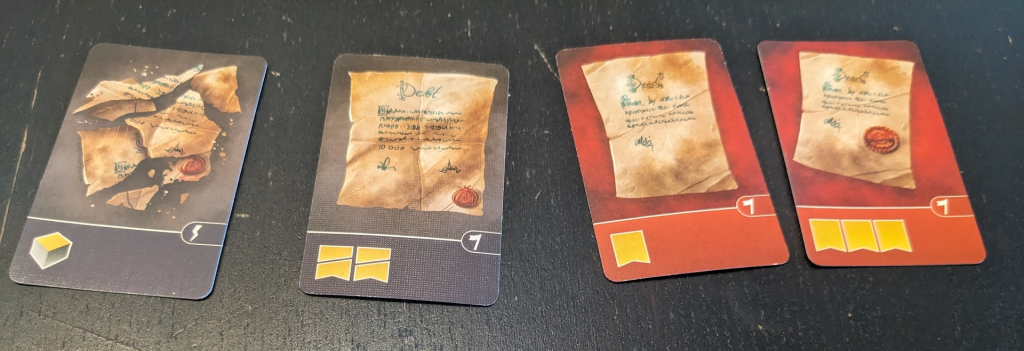
Picture by me!

I find this mechanism interesting because not only is it incredibly simple and fitting in the series’ focus on corruption and virtue, but also because gaining a Debt card is both a cost (-2 VPs), but also an opportunity (using a flip for a resource). Gaining a Debt card is an unvertain value: you can’t know whether you’ll have time to flip it or not, nor how much you’ll need the bonus. That Uncertainty means you can’t perfectly math out the result, which makes the decision more interesting.

It also opens up so much design room. It adds three actions (Gain a Debt, Gain a Deed, Flip a card) with a single rules, and those actions are of different value, which opens up the possibilities of combinations to interesting places by offering a way to balance outlier actions. Maybe getting 1 Gold per worker is too strong, but what if we give you a Debt for it? It adds an interesting dimension to your design space.

Now, what if you built a whole game out of this mechanism?

Bones!

You’d get Good Puppers (also known as One-Deck Puppies after the publisher’s more popular game series), one of my favourite little card games in existence. Now I know this is a stretch for this series: this isn’t a “filler” action, it’s literally the entire game. However, counter-argument: it’s my blog and I do what I want!

In One-Deck Puppies, you play doggo cards to piles of other doggos of that race. Card backs have a Bone value on each side: 1 – 2 – 5 – 10, to say how many points they’re worth.
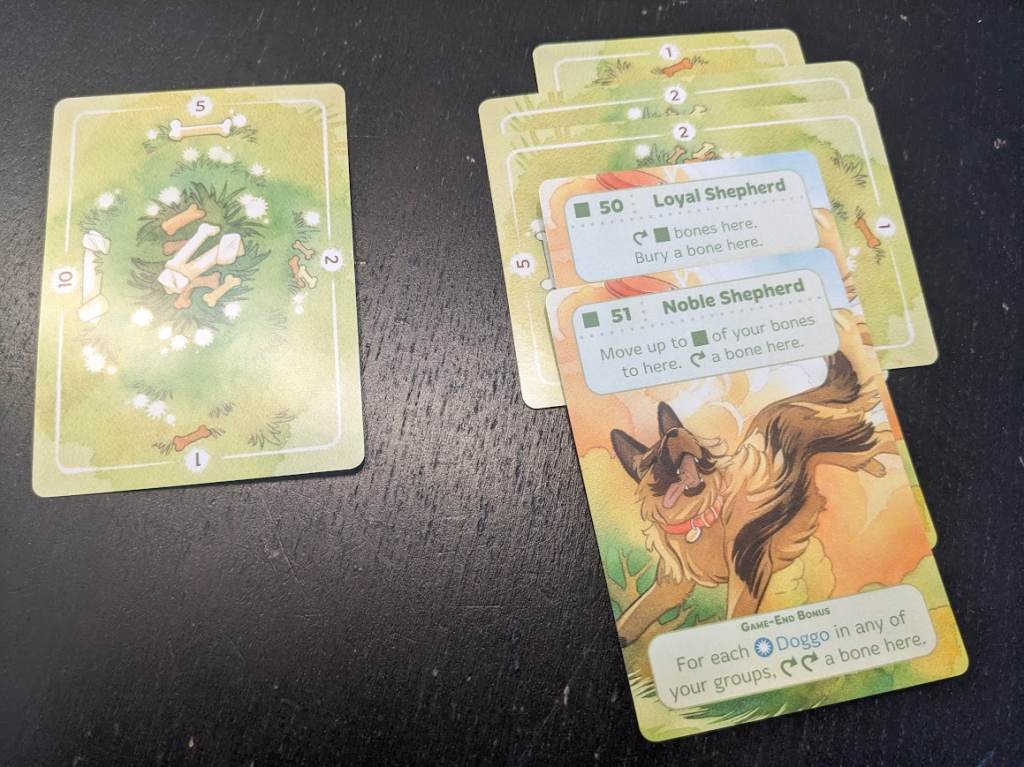
Another picture by me!

The game revolves around 3 actions: Bury a bone (place a facedown card from the deck behind this column, showing the 1-value bone), Flip a bone (increase it to its next value), and Move a bone (send it to a different column). The first two are conceptually equivalent to the Debts and Deeds we discussed above, although the Flip has the extra boost of having 4 values per card, instead of 2. The Movement, however, adds a LOT.

You see, a bone’s location can come up in a lot of different ways. It’s never just Flip a bone, it’s Flip a bone here, or Flip a bone under each column with X amount of doggos, or Flip half the bone in a specific column. It’s never just Bury a bone, it’s Bury a bone in every column without a Bone, or Bury as many bones here as you have doggos. Moving the bones to the right place can set up combos in a very, very satisfying way.


Both Debts and Bones are examples of resources which are also opportunities, which can make a game’s decision space richer and more nuanced without adding much rule overhead. It’s a simple system, but one rich enough to literally build an entire game around!

Can you think of another game that features a similar resource that is also an opportunity for a better result?

Variety without Headache #1 – Bracelets!

A large amount of game ideas I get revolve around a cool action selection mechanism (CASM, for short), which is a pretty popular subset of Euro games. However, when it comes to building out the actions for your CASM, there’s a pretty difficult line to toe: if they’re too similar, the CASM’s interesting decision space becomes a non-decision, but if they’re too different, you have too many subsystems to teach. Too simple, and the game becomes rote, but too complex, and they take the focus away from your CASM. You need to add variety without adding headaches. It’s quite a tricky tightrope, and it can quickly lead you astray.

This series looks at CASM-focused games with an original system that gives you actions to add meaning to your core CASM and opens up the design space for more content, without adding too much rules overhead. It’s sort of a sub-series of SISIGIP (Stuff I’d Steal in Games I Play).

As a disclaimer, I want to point out that a game is not just a pile of mechanisms of systems. A game tells a story out of interesting moments, which come out of interwoven mechanisms. You can’t just take your CASM, plug in all these actions and call it a game. This is meant to be praising and analyzing excellent design, which can hopefully serve as inspiration.

Knarr’s Bracelets

Knarr is centered around a really cool card play mechanism, where Viking cards have a colour and an action. When you play a Viking card, you activate its action, and that of all Vikings of that colour in your tableau. There are also Exploration cards, which give you a bunch of stuff, but to get those, you spend cards from your tableau. It leads to this push and pull where you want to keep your Vikings in your tableau for super turns, but you also want to spend them for the Exploration cards. Great central tension. First to 40 points wins. Simple, clean, elegant.

The actions you get are pretty straightforward: getting one VP, going up on a track (which eventually will give you VPs), gaining helmets (which are spent for Exploration cards)… and finally, bracelets. Thematically, bracelets are a sort of currency, and exploring opens up new trade routes. Mechanically, they do something quite interesting.

Picture by me

Each Exploration card has those three lines at the bottom, with some of them associated with effects. Bracelets are used to activate these: spend one bracelet to activate the leftmost column; spend two to activate the first two; spend three to activate all three.

At first sight, you could say this is just a second level of engine building in an engine building game, which it is. However, that simple mechanism (it can be taught in one sentence) opens up a tremendous amount of design space. Not only does it give you a fourth action at very little complexity cost, but adding that third variable on Exploration cards increases the variety of those cards exponentially, and makes the decision of when to explore much more interesting. Two birds with one mechanism!

Some CASM-focused games have a “travel” action as a filler, which usually has you move around a board to gain resources. They’ll give you 3 actions, and a fourth, which will be “move around to gain one of the other actions”. I, by en large, find those lazy and uninspired. Knarr takes this same concept and makes an action out of giving you stuff, but it feels so much more interesting. By combining it with the Exploration cards, which are an existing part of the CASM, it feels less like “gain a bunch of stuff”, and more like “activate these things I’ve fought for”. And then, the three columns give you an interesting decision: do I wait for a third, or send these 2 right now? Should I spend all 3, or spend 1 at a time for three turns?

So I have a few ideas for subsequent posts in this series, but let me know in the comments if you think of other mechanisms that fill this concept you’d like me to talk about!

What if money was useful? (SISIGIP #3)

Every now and again, I manage to play games, sometimes even play new ones, sometimes even good ones! And when I do, there’s often one mechanism that just sticks with me, a mechanism that I think about in the shower, in the car, in front of the fridge… This is what the SISIGIP series is about: Stuff I’d Steal in Games I Play. 

Many games have multi-use cards: I’d even say it’s one of my favourite mechanisms. One of my own games, Mapping the World, uses it. Multi use cards have a lot of pros: first and foremost, they make decisions richer through the power of combinations, but also, they help mitigate random card draw, like in Race for the Galaxy (RftG), where you pay for stuff by discarding cards. Actually, “card as money” has been used in many different games, often with some twists, like in Bloody Inn, Summoner Wars, or even Gloomhaven.

Well, Dollars to Donuts takes it one step further. Dollars to Donuts (DtD) has multi-use Dollars.

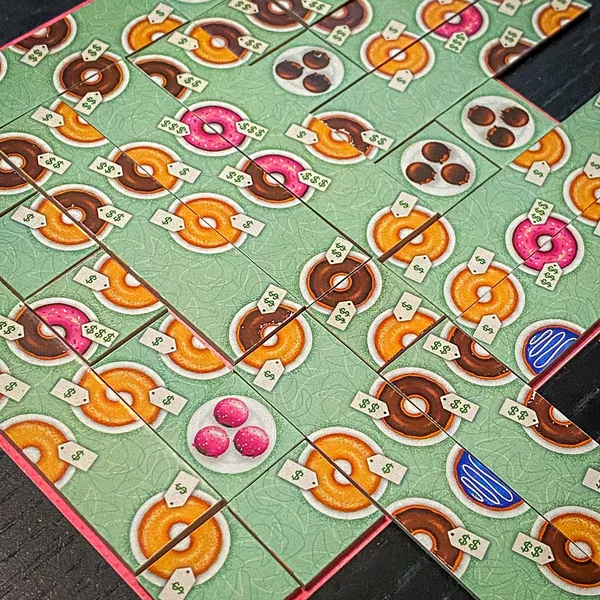
Dollars to Donuts is a tile laying game where you try to match donuts to gain points, or mismatch them to get money. Money is mostly used to buy tiles from a river-style display with diminishing cost. However, the special thing is that Money is a square tile. On one side, it shows a dollar, and on the other… well, it’s a tile, just like any other tile in the game. 

Picture from BGG user GeekyGaymerGuy

Where Donut tiles are 1 square wide, but 4 squares long, Dollars are a 1×1 tile, which can be used to go in and patch holes, or sometimes just give you more of a chance at the one donut flavour you’re looking for.

A Question of Perception

Mechanically, it is no different than the cards in RftG. Both can either be used individually for what they show, or spend in bulk to pay for stuff. What makes it different is how it is presented. In RftG, you draw cards, but any uninteresting card you can discard to pay for your tableau. In Dollars to Donuts, you gain money, and you can use a money tile to play in a gap. In RftG, the default is the card face; in DtD, it is the dollar. 

However, it’s not just a question of labels, although the label is indeed important. It’s about which use is the main focus of the item.

In RftG, the point of the game is to play cards to your tableau: sure, most of the cards you draw will be discarded, but when you draw, you have to select which cards you’ll try to play, and the tension in that is what makes the mechanism. 

In DtD, when you gain money, you usually do so because you intend to use it as money. When you look at the backsides, it often is an afterthought. Sometimes, you have matching donut holes (which score in pairs), or a small space on your board, or a donut flavour you can’t match from the market: then you look at your dollars, but they are dollars first. Because the odds are such, the most common emotional reaction to that draw is a pleasant surprise when you get a useful tile, not the disappointment when you don’t.

To be clear, I understand it’s not groundbreaking. A lot of what we consider innovative game mechanisms nowadays are less completely new systems than just presenting classics in a new, original way.

What does it do well?

In many games with money, you stack it, then spend it. Budgeting is a very rich strategic dimension in and of its own. 

In Dollars to Donuts, your relationship with money is different. Every dollar you make is like a lottery ticket: will it be the tile you need? Sometimes, you have 5$, but 2 of those dollars you want to keep as tiles: the decision on whether or not to spend 4$ is much more interesting, because adding that factor makes any two potential moves much harder to compare, which makes it more interesting (LINK).

Every dollar being unique also has an interesting impact on how you spend. Also, where in most games, money is a zero sum thing, in Dollars to Donuts, spending 5$ to gain 5$ is often a great move, as those are 5 new shots at getting a tile you need. Therefore, it makes people hoard less, and makes that economy more dynamic.

How would I use it?

I don’t think it’s a mechanism that requires much modification: aside from changing which actions are linked to money tiles, there isn’t much we can play around with. It’s also not a mechanism you can build a game around as much as just one you include in a game to make a part of it more interesting (EDIT: Since I wrote this, I played Salton Sea and was proven wrong. You can definitely build a game around this).

Like I said above, the mechanism disincentivizes hoarding money, making the economy more dynamic. In a way, it can help with the Healing Potion effect. I have a few prototypes I’ve worked on where I’d like to give people an avenue to use up their money without adding a new mechanism to the game, and so I gave them a try. 

Two pitfalls I identified when using this mechanism (and by identify I mean “fell right in, face first”) are that those effects have to be (a) simple, and (b) not add new rules. There’s a side mechanism in Mapping the World which had bothered me for a while, a currency which people were getting but hoarding. I switched it up to individual cards with their own effects… and now players got confused about what the tokens did, and what about this one, wait, is that different from X?

The next time I use a mechanism like this, I will try to keep the effects simple: spend this when doing action X to gain more stuff, or at a lower cost, that kind of things. No new mechanism, no nuanced effects of “this might make it better”, just a clear “when you do X, use it to do more”. Using your money cards for the boost is the interesting decision point, you don’t need to be cute with what the effect does.

Dynamic Markets… in reverse! (SISIGIP #2)

Pictured: Peak Game Design

Every now and again, I manage to play games, sometimes even play new ones, sometimes even good ones! And when I do, there’s often one mechanism that just sticks with me, a mechanism that I think about in the shower, in the car, in front of the fridge… This is what the SISIGIP series is about: Stuff I’d Steal in Games I Play.

A lot of games have dynamic markets, where an asset’s cost changes over the course of play: many games feature a card river, where a card’s cost decreases the longer it stays in the market; in Rococo, the cost is based on how many choices are available; in Jorvik, a card costs 1$ per player in line to buy it.

These mechanisms take the decision of “do I buy X?” and make it into the much more interesting “do I buy X now, at this price?” That comes with a certain amount of push-your-luck, and the variable amounts helps balance each asset to a group’s particular meta, keeping things fresh and pushing players to vary their paths from game to game. Whether the game is entirely built around that dynamic market, like Jorvik or Spyrium, or if it’s a secondary mechanism, dynamic markets are great.

Rival Networks goes in a different direction: its market is static, but the money itself is dynamic.

Rival Networks is a 2p game about running a TV station. The game is centered around building TV shows in each of three timeslots, scoring them for majority at the end of a round. Instead of money tokens, Rival Networks gives you Ad cards, which have two values: a basic value, and a higher one if you, when you use it, hold the majority in its stated timeslot.

Who doesn’t like hair in their burgers?

What it does well (and less well)

The Ad mechanism offers a similar core decision as a dynamic cost would: it adds a timing, push-your-luck element to buying cards. Instead of “maybe the price will go down…”, you think “oh, maybe I can take the morning majority this turn and buy it the next”. The main difference is that it gives agency over the change in value, rather than something that just happens to you.

The Ad mechanism also gives you a first level strategy, which in and of itself is valuable (LINK). That pulls double duty in a majority game, where early turns can feel meaningless as you are more likely to get passed before scoring happens. The Ad mechanism makes you focus on one specific timeslot and gives you a reason to go for it early.

The one thing where it falls short of a card river is the balancing. Some groups who play Yokohama repeatedly will develop their own meta, and if they decide that University is an overpowered technology, they’ll pay the big bucks and get it as soon as it shows up. Similarly, the river might push players to take a card they wouldn’t usually go for, just because it’s dirt cheap. Rival Networks doesn’t have that: if you and your opponent play the game repeatedly and decide that Auditions is an OP card and Spinoffs is worthless, you won’t get nudged away from that.

How I would use it

Despite that weakness, I think that the dynamic currency is an interesting twist on a card river. I can think of three uses:

The first idea is focused on minimizing that weakness by limiting the variety of assets you can buy with those. Rivals Networks uses it to buy special ability cards, which usually are high-variety assets that you want your players to explore. You could instead make the market a scoring system. Rather than scoring a majority after each round, a player can determine when they score by, say, spending a turn to buy point tokens for 10$ each. For an added twist, the point values go down, incentivizing you to snatch them early. Basically, we’re taking the first-level strategy perk of this mechanism and making it into the central scoring system. It also means you can avoid a round-based gameplay.

If you really want to do an upgrade market, something where you want players to dig into new territory over repeated plays, you can combine this mechanism with a little bit of a dynamic market: you don’t want to have both variable money and variable costs, which would be much too swingy and frustrating, but you can go the Puerto Rico way and add a small bonus to every unchosen card. Eventually, those bonuses pile up, the forgotten upgrade will get snatched up, and that player will feel good about getting 6 points with their upgrade, even if they missed out on their favourite card.

My third idea goes in a different direction. Rather than focus on what you buy, I’m thinking about changing how you buy those assets: specifically, I’m thinking of an auction. Let’s imagine a tile-laying game a la Carcassonne, where players take turns building out a landscape and claiming parts of it, with the cards in their hands giving them objectives to fulfill (for example, 1$, or 4$ if there are at least 3 lakes). You go around like that until a player calls an auction. Maybe we’re auctioning off a special ability, an extra placement, or a unique tile, it doesn’t matter. Suddenly, the question “do I buy X now?” takes a new meaning: will you spend a card at less than its full value to take the opportunity? When do you give up on the increased value? That, to me, feels like a different decision space worth exploring.

Conclusion

I hope my appreciation for this mechanism came through in this post. While not perfect, it is an interesting twist to all of the dynamic market mechanisms we see in many games, and one I hope we’ll see more often in the future.

Have you played another game with a similar mechanism? If you’re a game designer, how would you use it?

Winning! An alternative to “most points” (SISIGIP #1)

It’s been a while, Internet. Life has been hectic, and playing few games meant I thought about design less. But now that life is calming down some, and that I’m gaming a lot…

So to get back into writing, I’ve decided to dig into my notebook and look at the SISIGIP section (Stuff I’d Steal In Games I Play): every time I play a new game, I write down one small mechanism that inspires me. It’s kind of like Jamey Stegmaier’s “My Favourite Mechanism in…” series, but I’m focusing more on small pieces rather than the main selling point, and thinking more about where it could fit in a game, or how it could be used differently.

Today, I’m starting the SISIGIP series by talking about Winning conditions: after a game is over, how do you know who won it? As a Euro gamer, I play a lot of Most-VPs-Wins games, but I’m starting to sway more and more towards games which avoid the end game accounting associated with those.

There are a lot of different ways to define victory conditions, but a lot of better writers have tackled those questions before: my first draft of this article was basically repeating Alex Harkey’s Games Precipice article about “Most, First, Last” (link). To recap, the article presents three types of victory conditions: Most (most point-based games), First (race games, but also mission-based), and Last (survival games). More interestingly, they then talk about games with multiple victory conditions, like how in King of Tokyo, you can either be the first to 20 points, or the last monster standing, or in 7 Wonders Duel, which is a most VP game, except for two instant-win conditions if you can manage to complete them (which are, in a way, a mix of first and last, but the line is blurry in a 2-player game).

But in all of these cases, the examples were about multiple, unrelated winning conditions, divided by OR: get to 20 points OR be the last standing; have 5 Sciences, OR reach your opponent’s city, OR have the most points.

Spirit Island‘s Fear System

When I played Spirit Island recently, the Fear system jumped out to me as such a rich victory condition. If you don’t know the game, it is a coop game where you play as Spirits defending an island against colonists laying claim over your land. If you break it down to a very deep, core level, it follows the Pandemic-frame: you must control the unending threat of colonists (playing the role of disease cubes) while making progress towards your goal by accumulating Fear (playing the role of cures). However, how those two aspects translate to the winning condition is very different.

In Pandemic, winning is straightforward: “Find 4 Cures before you lose”. The cubes affect the losing, but not the winning.

In Spirit Island, the winning condition starts as “Get rid of all Colonists”. Every time you get 4 Fear, you gain a small bonus event card; after the third (therefore, after 12 Fear), the win condition becomes one step easier. First, it allows you to ignore the least powerful type of Colonists, and becomes “Get rid of all Towns and Cities”, and then after another 12 Fear, “Get rid of all Cities”. Then, if you gain another 12 Fear, you just immediately win, regardless of board state, just like with 4 Cures in Pandemic.

It would be like if Pandemic‘s winning condition started off as “Win if there are no disease cube”, and after the first Cure, became “Win if there are no cities with 2 or 3 cubes”, then “Win if there are no cities with 3 cubes” after the second, and then “Win if there is no more than one city with 3 cubes”. Then, on the fourth Cure, you win, like in the current game.

What it does well

In Pandemic, you either play defensively by taking cubes away, or offensively by working towards the cures. Mostly, you try to play as offensively as you can, switching to defense when it’s required, because you’re still working against a ticking clock. The puzzle of the game comes in making those switches as seamless as possible: “if I go there to cure cubes, I can also give you this card”. If you play too defensively, you lose: you must take action.

In Spirit Island, you can technically win by killing all Colonists and staying on the first victory condition, or you can win without killing a Colonist, by moving them around or defending against their effects, and by producing 36 Fear before you lose. In reality, most games will be a mix of the two, but it makes “playing defensively” viable.

What makes the Fear System work so well, too, is how different the two axes feel. Gaining Fear is often a thing of manipulation, with a lot of fear-generating effects having “if” or “for each” clauses, and you must still find a way to survive the Colonists’ attacks. On the other hand, Fear gained is never lost. Getting rid of Colonists, however, is a much more direct thing, requiring both frontal assaults by the Spirits and by the island’s natives, the Dahan. They are their own form of defense, but any progress is temporary: more Colonists will come next turn, and the one after. When it comes to the winning condition, Fear is a one-way track, but Colonists are a snapshot: you can rid the board of all Towns and Settlers for a push to victory, but if you were to keep on playing, more would come.

By comparison, Rajas of the Ganges is a popular competitive game with a similar system: there are score tracks, one tracking your money, and one your Fame, and they go in opposite directions. If your markers ever reach one another, you win. In theory, it is a very similar system to Spirit Island’s: you could say that gaining money lowers your victory threshold, or vice versa. However, gaining Fame and gaining Money feel very similar, despite being gained from different systems. If the game had been created with only one point-type, and a single-threshold, the gameplay would not have changed much, I think.

How would I use it?

The Fear system has inspired two mechanisms for me, one for my Coop game SuPR, and one for a competitive game that’s still just scribbles in my notebook.

The first thing that came to mind is “can we play with the number of Fear needed to advance?” That could add one more dimension to play with and link abilities to, but also a very interesting timing element: Fear production is more effective when the threshold is low, so you must strike when the iron is hot!

In SuPR, players are a PR firm working for a Superhero, trying to get them to be liked by the general public. Where in Spirit Island you gain Fear and defeat Colonists, in SuPR you gain Reputation and defeat Supervillains. To me, the Fear mechanism was an obvious move, and a mechanism I wanted to work with. Interestingly, playing with the threshold for advancement had a great mechanical implication: the more dire the situation was, the more heroic your actions were! Mechanically, every neighbourhood’s Hope represented both its “health points”, and how much Heroism you needed to gain Reputation. This added an interesting layer of strategy: how far will you let things slip before you go in to save the day? It added a cynical aspect to the theme, too, which I loved to play with.

In the competitive space, I like games without point systems, which feel a lot more dramatic than the accounting session at the end of my favourite games. Games where you can just reach a certain situation, and WIN. However, more often than not, when I try to design those, they end up with a Munchkin effect: it’s not about being able to Win, but about being able to Win WHEN NO ONE CAN BLOCK YOU, which I think only works in a 2-player game.

However, my scribble concept went to a game about politicians and lobbyists. Every player is a politician, with some key lobbies supporting them. You start the game with, say, 6 cards dictating a certain board state: one says that the education budget must be over 10, another that the tax rate must be under 5. But, of course, both are related, and lowering the tax rate also lowers the education budget. And one of your opponent is pushing for the budget to go to infrastructure. If, at any point during the game, all 10 of your cards are completed, like the victory condition in Spirit Island, you win. Also, throughout the game, certain events and actions lead to Popularity Boosts. When you gain a Popularity Boost, you get to discard one of your Objective cards: now, you only need 5 objectives to be true, then 4, then 3. Like in Spirit Island, you could win through sheer Popularity, but odds are it will be a mix of the two.

Quickly, you’ll get an idea of what other players are pushing, and who is pushing against you. However, the game is not about waiting for others to be out of sticks to put in your wheels, but to, over time, lower your threshold so that you can hit at the right time.

Conclusion

I think there’s a lot that can be done to make the process of determining a winner more dynamic, without losing the granularity and feeling of progress of victory points. Spirit Island’s Fear system is only one of them. What other games explore that space in dramatic, interesting ways? Have you explored that in your own designs?