What if money was useful? (SISIGIP #3)

Every now and again, I manage to play games, sometimes even play new ones, sometimes even good ones! And when I do, there’s often one mechanism that just sticks with me, a mechanism that I think about in the shower, in the car, in front of the fridge… This is what the SISIGIP series is about: Stuff I’d Steal in Games I Play. 

Many games have multi-use cards: I’d even say it’s one of my favourite mechanisms. One of my own games, Mapping the World, uses it. Multi use cards have a lot of pros: first and foremost, they make decisions richer through the power of combinations, but also, they help mitigate random card draw, like in Race for the Galaxy (RftG), where you pay for stuff by discarding cards. Actually, “card as money” has been used in many different games, often with some twists, like in Bloody Inn, Summoner Wars, or even Gloomhaven.

Well, Dollars to Donuts takes it one step further. Dollars to Donuts (DtD) has multi-use Dollars.

Dollars to Donuts is a tile laying game where you try to match donuts to gain points, or mismatch them to get money. Money is mostly used to buy tiles from a river-style display with diminishing cost. However, the special thing is that Money is a square tile. On one side, it shows a dollar, and on the other… well, it’s a tile, just like any other tile in the game. 
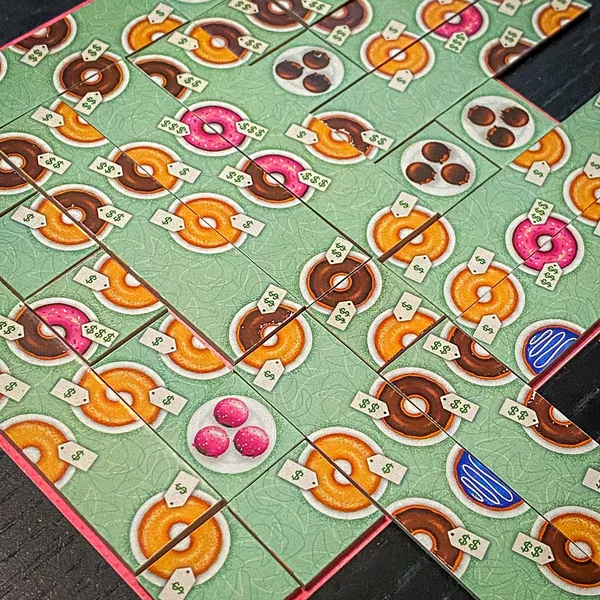
Picture from BGG user GeekyGaymerGuy

Where Donut tiles are 1 square wide, but 4 squares long, Dollars are a 1×1 tile, which can be used to go in and patch holes, or sometimes just give you more of a chance at the one donut flavour you’re looking for.

A Question of Perception

Mechanically, it is no different than the cards in RftG. Both can either be used individually for what they show, or spend in bulk to pay for stuff. What makes it different is how it is presented. In RftG, you draw cards, but any uninteresting card you can discard to pay for your tableau. In Dollars to Donuts, you gain money, and you can use a money tile to play in a gap. In RftG, the default is the card face; in DtD, it is the dollar. 

However, it’s not just a question of labels, although the label is indeed important. It’s about which use is the main focus of the item.

In RftG, the point of the game is to play cards to your tableau: sure, most of the cards you draw will be discarded, but when you draw, you have to select which cards you’ll try to play, and the tension in that is what makes the mechanism. 

In DtD, when you gain money, you usually do so because you intend to use it as money. When you look at the backsides, it often is an afterthought. Sometimes, you have matching donut holes (which score in pairs), or a small space on your board, or a donut flavour you can’t match from the market: then you look at your dollars, but they are dollars first. Because the odds are such, the most common emotional reaction to that draw is a pleasant surprise when you get a useful tile, not the disappointment when you don’t.

To be clear, I understand it’s not groundbreaking. A lot of what we consider innovative game mechanisms nowadays are less completely new systems than just presenting classics in a new, original way.

What does it do well?

In many games with money, you stack it, then spend it. Budgeting is a very rich strategic dimension in and of its own. 

In Dollars to Donuts, your relationship with money is different. Every dollar you make is like a lottery ticket: will it be the tile you need? Sometimes, you have 5$, but 2 of those dollars you want to keep as tiles: the decision on whether or not to spend 4$ is much more interesting, because adding that factor makes any two potential moves much harder to compare, which makes it more interesting (LINK).

Every dollar being unique also has an interesting impact on how you spend. Also, where in most games, money is a zero sum thing, in Dollars to Donuts, spending 5$ to gain 5$ is often a great move, as those are 5 new shots at getting a tile you need. Therefore, it makes people hoard less, and makes that economy more dynamic.

How would I use it?

I don’t think it’s a mechanism that requires much modification: aside from changing which actions are linked to money tiles, there isn’t much we can play around with. It’s also not a mechanism you can build a game around as much as just one you include in a game to make a part of it more interesting (EDIT: Since I wrote this, I played Salton Sea and was proven wrong. You can definitely build a game around this).

Like I said above, the mechanism disincentivizes hoarding money, making the economy more dynamic. In a way, it can help with the Healing Potion effect. I have a few prototypes I’ve worked on where I’d like to give people an avenue to use up their money without adding a new mechanism to the game, and so I gave them a try. 

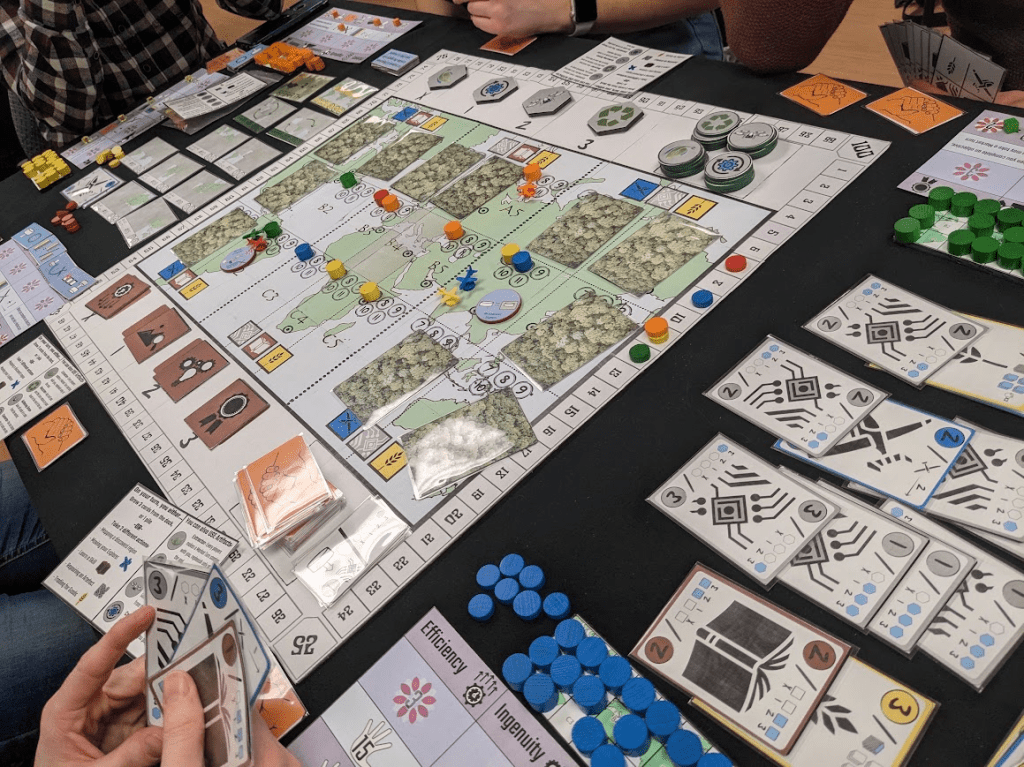
Two pitfalls I identified when using this mechanism (and by identify I mean “fell right in, face first”) are that those effects have to be (a) simple, and (b) not add new rules. There’s a side mechanism in Mapping the World which had bothered me for a while, a currency which people were getting but hoarding. I switched it up to individual cards with their own effects… and now players got confused about what the tokens did, and what about this one, wait, is that different from X?
The next time I use a mechanism like this, I will try to keep the effects simple: spend this when doing action X to gain more stuff, or at a lower cost, that kind of things. No new mechanism, no nuanced effects of “this might make it better”, just a clear “when you do X, use it to do more”. Using your money cards for the boost is the interesting decision point, you don’t need to be cute with what the effect does.
Dynamic Markets… in reverse! (SISIGIP #2)

Pictured: Peak Game Design

Every now and again, I manage to play games, sometimes even play new ones, sometimes even good ones! And when I do, there’s often one mechanism that just sticks with me, a mechanism that I think about in the shower, in the car, in front of the fridge… This is what the SISIGIP series is about: Stuff I’d Steal in Games I Play.

A lot of games have dynamic markets, where an asset’s cost changes over the course of play: many games feature a card river, where a card’s cost decreases the longer it stays in the market; in Rococo, the cost is based on how many choices are available; in Jorvik, a card costs 1$ per player in line to buy it.

These mechanisms take the decision of “do I buy X?” and make it into the much more interesting “do I buy X now, at this price?” That comes with a certain amount of push-your-luck, and the variable amounts helps balance each asset to a group’s particular meta, keeping things fresh and pushing players to vary their paths from game to game. Whether the game is entirely built around that dynamic market, like Jorvik or Spyrium, or if it’s a secondary mechanism, dynamic markets are great.

Rival Networks goes in a different direction: its market is static, but the money itself is dynamic.

Rival Networks is a 2p game about running a TV station. The game is centered around building TV shows in each of three timeslots, scoring them for majority at the end of a round. Instead of money tokens, Rival Networks gives you Ad cards, which have two values: a basic value, and a higher one if you, when you use it, hold the majority in its stated timeslot.

Who doesn’t like hair in their burgers?

What it does well (and less well)

The Ad mechanism offers a similar core decision as a dynamic cost would: it adds a timing, push-your-luck element to buying cards. Instead of “maybe the price will go down…”, you think “oh, maybe I can take the morning majority this turn and buy it the next”. The main difference is that it gives agency over the change in value, rather than something that just happens to you.

The Ad mechanism also gives you a first level strategy, which in and of itself is valuable (LINK). That pulls double duty in a majority game, where early turns can feel meaningless as you are more likely to get passed before scoring happens. The Ad mechanism makes you focus on one specific timeslot and gives you a reason to go for it early.

The one thing where it falls short of a card river is the balancing. Some groups who play Yokohama repeatedly will develop their own meta, and if they decide that University is an overpowered technology, they’ll pay the big bucks and get it as soon as it shows up. Similarly, the river might push players to take a card they wouldn’t usually go for, just because it’s dirt cheap. Rival Networks doesn’t have that: if you and your opponent play the game repeatedly and decide that Auditions is an OP card and Spinoffs is worthless, you won’t get nudged away from that.

How I would use it

Despite that weakness, I think that the dynamic currency is an interesting twist on a card river. I can think of three uses:

The first idea is focused on minimizing that weakness by limiting the variety of assets you can buy with those. Rivals Networks uses it to buy special ability cards, which usually are high-variety assets that you want your players to explore. You could instead make the market a scoring system. Rather than scoring a majority after each round, a player can determine when they score by, say, spending a turn to buy point tokens for 10$ each. For an added twist, the point values go down, incentivizing you to snatch them early. Basically, we’re taking the first-level strategy perk of this mechanism and making it into the central scoring system. It also means you can avoid a round-based gameplay.

If you really want to do an upgrade market, something where you want players to dig into new territory over repeated plays, you can combine this mechanism with a little bit of a dynamic market: you don’t want to have both variable money and variable costs, which would be much too swingy and frustrating, but you can go the Puerto Rico way and add a small bonus to every unchosen card. Eventually, those bonuses pile up, the forgotten upgrade will get snatched up, and that player will feel good about getting 6 points with their upgrade, even if they missed out on their favourite card.

My third idea goes in a different direction. Rather than focus on what you buy, I’m thinking about changing how you buy those assets: specifically, I’m thinking of an auction. Let’s imagine a tile-laying game a la Carcassonne, where players take turns building out a landscape and claiming parts of it, with the cards in their hands giving them objectives to fulfill (for example, 1$, or 4$ if there are at least 3 lakes). You go around like that until a player calls an auction. Maybe we’re auctioning off a special ability, an extra placement, or a unique tile, it doesn’t matter. Suddenly, the question “do I buy X now?” takes a new meaning: will you spend a card at less than its full value to take the opportunity? When do you give up on the increased value? That, to me, feels like a different decision space worth exploring.

Conclusion

I hope my appreciation for this mechanism came through in this post. While not perfect, it is an interesting twist to all of the dynamic market mechanisms we see in many games, and one I hope we’ll see more often in the future.

Have you played another game with a similar mechanism? If you’re a game designer, how would you use it?

Spicing up your resource management

I like Euro games. I like indirect interaction, engine building and puzzly, interrelated systems. I like Victory Points and delivering cubes to get them. And there’s also resource management.

Resource management is one of those things that is in most games, but often doesn’t seem to have had much thought behind how it was implemented. However, some games have interesting, well thought out resource systems, and they really shine. Kinda like mashed potatoes at a restaurant: it’s often the forgettable, bland side dish, but sometimes, you get something creamy, buttery, savory… Hmmm, I love me some creamy resource management.

I think the biggest pitfall of resource management is that resources are interchangeable. We collect green cubes and black cubes and blue cubes, we get all of them by placing workers and use all of them for recipe fulfillment. The only thing that makes a blue cube different from a black cube is which recipe I have access to right now.

If your design is suffering from bland resource management, here are a few solutions for you to try out!

Assign each resource a specific action

If all resources are used in the same way, it’s very hard to make them feel meaningfully different. If the only difference between a Stone and a Wood is that building cards use them in different amounts, then there is no inherent difference between the two.

By comparison, look at Viscounts of the West Kingdoms: there are four actions in the game, and four resources. Writing costs Ink, Building costs Stone, Trading costs Money, and Influencing costs Gold. Each action is different, therefore each resource is different.

However, some games are too simple for this, and have one main way to convert resources into action: in that case…

Make some resources more valuable / rarer

In a game like Century, you use your spices to buy point cards, and that’s the whole game. However, the four resource types are not equal: some actions will turn lower quality cubes into higher ones, or a single higher one in many of lower values. This difference in value inherently means that having a handful of turmeric cubes will feel different from a handful of more expensive cinnamons, even if they still are only used to fulfill the same kinds of contracts.

Picture from BGG user @zgabor

Similarly, many worker placement games like Lords of Waterdeep will assign resources a different value.  You can easily see that based on how many of them you can gain from one action: 4 coins, 2 fighters, but only 1 wizard. Or Lost Ruins of Arnak, where the basic actions give 2 Tablets, 1 Arrowhead, 1 Ruby with a small cost. It doesn’t seem like much, but it makes quite a difference.

Power Grid has an open market for resources, all of them having a different rate of refill at the end of round, and a different distribution amongst the factories that consume them. While it is player driven, the market system will still tend to make Uranium and Oil safer bets, and Trash and Coal more swingy.

Picture from BGG user @tdakanalis

Sometimes, available resources are randomly revealed, and some resources are simply rarer, making them more valuable: games like Five Tribes and Rococo go in this direction. Depending on how the rest of your game functions, that might be an interesting system.

Give some resources a specific mechanism

Obviously, saying “find a cool puzzle to build your game around” is neither satisfying nor helpful, but sometimes, a simple mechanic that applies to some resources but not others is enough to open up a lot of design space. 

One of the best examples of this is Brass: Lancashire. This classic has three resources: money, coal, and iron. Money does not have anything special about it: it is earned, and kept until it’s spent. Coal and Iron, however, are associated to buildings, and when a building is emptied, its owner gains both income and points. Additionally, Coal and Iron are different in one important way: Coal must be transported from the building containing it to the city where it will be used through rails or canals, while Iron does not require this infrastructure.

Another example which we’ve grown accustomed to because of its ubiquity in gaming is Agricola’s resource trifecta: Animals must be held in a pasture or building and can reproduce; Plants can be sown so you get “income” for the next few turns; and Materials, which are earned then spent. Its thematic obviousness sorts of dulls its impact, but that is quite a mechanically interesting system.

I also want to point out that both of those examples also support a theme or core aspect of the game: for Brass, it’s the infrastructure growth, while in Agricola, it’s the idealized farmer life. Not only do these mechanisms make the game more interesting on their own and serve as starting points for other mechanical elements, but they also participate in making the game feel like a whole, rather than a pile of ill-matched mechanisms.

A few more rapidfire examples: 

  • In The Rocketeer, you have two resources: Grit and Clout. Grit is assigned to one of your three characters, while Clout is shared amongst your team;
  • In Barrage, your money is earned then spent, but your tools are only temporarily unavailable when used;
  • In Keyflower, you have resources which are on tiles and must be moved around, and skill tiles which are held behind your shield;
  • In Space Explorers, you can either pay for your cards by giving resources to the player to your left, or by discarding cards from your hand to the public market.

In conclusion, going from a “soulless cube-pusher” to a richer, more interesting experience, often relies on making each resource feel different to add a bit of oomph. Whether that’s by associating each with a specific action, by toying with value and frequency, or by adding a different mechanism to some of them, you can both make your game spicier and more thematic.

Think about some of the resource management games you’ve played recently: how did they differentiate between those resources, how did they make their system more attractive? Of course, feel free to share in the comments and like and subscribe and all that jazz!