What if money was useful? (SISIGIP #3)

Every now and again, I manage to play games, sometimes even play new ones, sometimes even good ones! And when I do, there’s often one mechanism that just sticks with me, a mechanism that I think about in the shower, in the car, in front of the fridge… This is what the SISIGIP series is about: Stuff I’d Steal in Games I Play. 

Many games have multi-use cards: I’d even say it’s one of my favourite mechanisms. One of my own games, Mapping the World, uses it. Multi use cards have a lot of pros: first and foremost, they make decisions richer through the power of combinations, but also, they help mitigate random card draw, like in Race for the Galaxy (RftG), where you pay for stuff by discarding cards. Actually, “card as money” has been used in many different games, often with some twists, like in Bloody Inn, Summoner Wars, or even Gloomhaven.

Well, Dollars to Donuts takes it one step further. Dollars to Donuts (DtD) has multi-use Dollars.

Dollars to Donuts is a tile laying game where you try to match donuts to gain points, or mismatch them to get money. Money is mostly used to buy tiles from a river-style display with diminishing cost. However, the special thing is that Money is a square tile. On one side, it shows a dollar, and on the other… well, it’s a tile, just like any other tile in the game. 
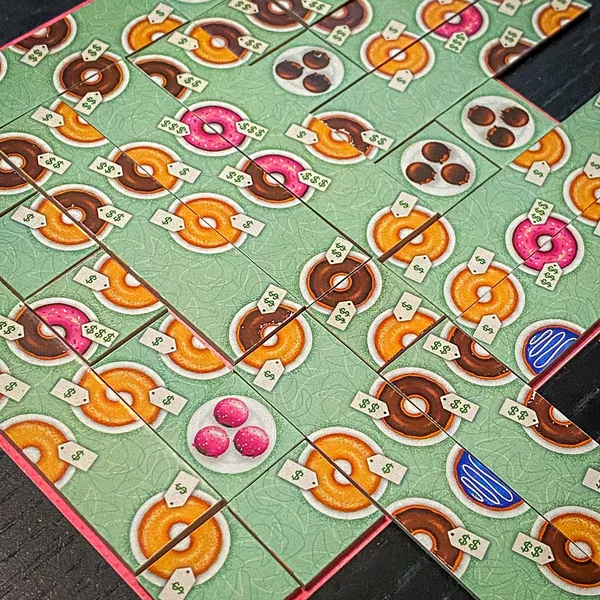
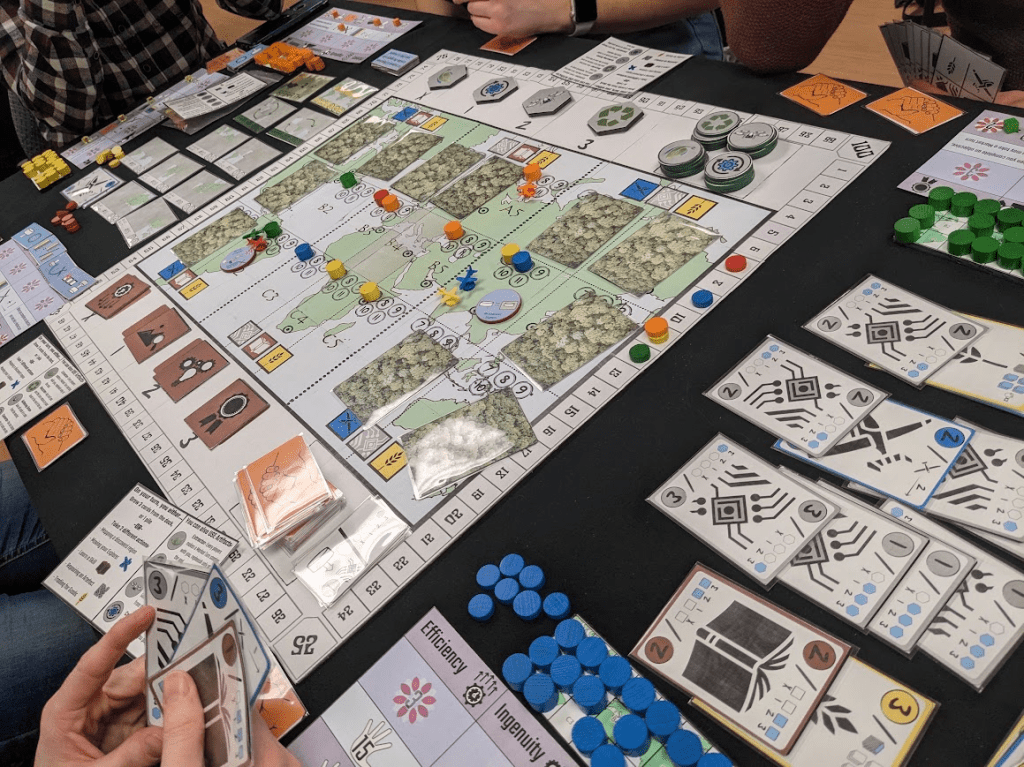
Picture from BGG user GeekyGaymerGuy

Where Donut tiles are 1 square wide, but 4 squares long, Dollars are a 1×1 tile, which can be used to go in and patch holes, or sometimes just give you more of a chance at the one donut flavour you’re looking for.

A Question of Perception

Mechanically, it is no different than the cards in RftG. Both can either be used individually for what they show, or spend in bulk to pay for stuff. What makes it different is how it is presented. In RftG, you draw cards, but any uninteresting card you can discard to pay for your tableau. In Dollars to Donuts, you gain money, and you can use a money tile to play in a gap. In RftG, the default is the card face; in DtD, it is the dollar. 

However, it’s not just a question of labels, although the label is indeed important. It’s about which use is the main focus of the item.

In RftG, the point of the game is to play cards to your tableau: sure, most of the cards you draw will be discarded, but when you draw, you have to select which cards you’ll try to play, and the tension in that is what makes the mechanism. 

In DtD, when you gain money, you usually do so because you intend to use it as money. When you look at the backsides, it often is an afterthought. Sometimes, you have matching donut holes (which score in pairs), or a small space on your board, or a donut flavour you can’t match from the market: then you look at your dollars, but they are dollars first. Because the odds are such, the most common emotional reaction to that draw is a pleasant surprise when you get a useful tile, not the disappointment when you don’t.

To be clear, I understand it’s not groundbreaking. A lot of what we consider innovative game mechanisms nowadays are less completely new systems than just presenting classics in a new, original way.

What does it do well?

In many games with money, you stack it, then spend it. Budgeting is a very rich strategic dimension in and of its own. 

In Dollars to Donuts, your relationship with money is different. Every dollar you make is like a lottery ticket: will it be the tile you need? Sometimes, you have 5$, but 2 of those dollars you want to keep as tiles: the decision on whether or not to spend 4$ is much more interesting, because adding that factor makes any two potential moves much harder to compare, which makes it more interesting (LINK).

Every dollar being unique also has an interesting impact on how you spend. Also, where in most games, money is a zero sum thing, in Dollars to Donuts, spending 5$ to gain 5$ is often a great move, as those are 5 new shots at getting a tile you need. Therefore, it makes people hoard less, and makes that economy more dynamic.

How would I use it?

I don’t think it’s a mechanism that requires much modification: aside from changing which actions are linked to money tiles, there isn’t much we can play around with. It’s also not a mechanism you can build a game around as much as just one you include in a game to make a part of it more interesting (EDIT: Since I wrote this, I played Salton Sea and was proven wrong. You can definitely build a game around this).

Like I said above, the mechanism disincentivizes hoarding money, making the economy more dynamic. In a way, it can help with the Healing Potion effect. I have a few prototypes I’ve worked on where I’d like to give people an avenue to use up their money without adding a new mechanism to the game, and so I gave them a try. 

Two pitfalls I identified when using this mechanism (and by identify I mean “fell right in, face first”) are that those effects have to be (a) simple, and (b) not add new rules. There’s a side mechanism in Mapping the World which had bothered me for a while, a currency which people were getting but hoarding. I switched it up to individual cards with their own effects… and now players got confused about what the tokens did, and what about this one, wait, is that different from X?
The next time I use a mechanism like this, I will try to keep the effects simple: spend this when doing action X to gain more stuff, or at a lower cost, that kind of things. No new mechanism, no nuanced effects of “this might make it better”, just a clear “when you do X, use it to do more”. Using your money cards for the boost is the interesting decision point, you don’t need to be cute with what the effect does.
Dynamic Markets… in reverse! (SISIGIP #2)

Pictured: Peak Game Design

Every now and again, I manage to play games, sometimes even play new ones, sometimes even good ones! And when I do, there’s often one mechanism that just sticks with me, a mechanism that I think about in the shower, in the car, in front of the fridge… This is what the SISIGIP series is about: Stuff I’d Steal in Games I Play.

A lot of games have dynamic markets, where an asset’s cost changes over the course of play: many games feature a card river, where a card’s cost decreases the longer it stays in the market; in Rococo, the cost is based on how many choices are available; in Jorvik, a card costs 1$ per player in line to buy it.

These mechanisms take the decision of “do I buy X?” and make it into the much more interesting “do I buy X now, at this price?” That comes with a certain amount of push-your-luck, and the variable amounts helps balance each asset to a group’s particular meta, keeping things fresh and pushing players to vary their paths from game to game. Whether the game is entirely built around that dynamic market, like Jorvik or Spyrium, or if it’s a secondary mechanism, dynamic markets are great.

Rival Networks goes in a different direction: its market is static, but the money itself is dynamic.

Rival Networks is a 2p game about running a TV station. The game is centered around building TV shows in each of three timeslots, scoring them for majority at the end of a round. Instead of money tokens, Rival Networks gives you Ad cards, which have two values: a basic value, and a higher one if you, when you use it, hold the majority in its stated timeslot.

Who doesn’t like hair in their burgers?

What it does well (and less well)

The Ad mechanism offers a similar core decision as a dynamic cost would: it adds a timing, push-your-luck element to buying cards. Instead of “maybe the price will go down…”, you think “oh, maybe I can take the morning majority this turn and buy it the next”. The main difference is that it gives agency over the change in value, rather than something that just happens to you.

The Ad mechanism also gives you a first level strategy, which in and of itself is valuable (LINK). That pulls double duty in a majority game, where early turns can feel meaningless as you are more likely to get passed before scoring happens. The Ad mechanism makes you focus on one specific timeslot and gives you a reason to go for it early.

The one thing where it falls short of a card river is the balancing. Some groups who play Yokohama repeatedly will develop their own meta, and if they decide that University is an overpowered technology, they’ll pay the big bucks and get it as soon as it shows up. Similarly, the river might push players to take a card they wouldn’t usually go for, just because it’s dirt cheap. Rival Networks doesn’t have that: if you and your opponent play the game repeatedly and decide that Auditions is an OP card and Spinoffs is worthless, you won’t get nudged away from that.

How I would use it

Despite that weakness, I think that the dynamic currency is an interesting twist on a card river. I can think of three uses:

The first idea is focused on minimizing that weakness by limiting the variety of assets you can buy with those. Rivals Networks uses it to buy special ability cards, which usually are high-variety assets that you want your players to explore. You could instead make the market a scoring system. Rather than scoring a majority after each round, a player can determine when they score by, say, spending a turn to buy point tokens for 10$ each. For an added twist, the point values go down, incentivizing you to snatch them early. Basically, we’re taking the first-level strategy perk of this mechanism and making it into the central scoring system. It also means you can avoid a round-based gameplay.

If you really want to do an upgrade market, something where you want players to dig into new territory over repeated plays, you can combine this mechanism with a little bit of a dynamic market: you don’t want to have both variable money and variable costs, which would be much too swingy and frustrating, but you can go the Puerto Rico way and add a small bonus to every unchosen card. Eventually, those bonuses pile up, the forgotten upgrade will get snatched up, and that player will feel good about getting 6 points with their upgrade, even if they missed out on their favourite card.

My third idea goes in a different direction. Rather than focus on what you buy, I’m thinking about changing how you buy those assets: specifically, I’m thinking of an auction. Let’s imagine a tile-laying game a la Carcassonne, where players take turns building out a landscape and claiming parts of it, with the cards in their hands giving them objectives to fulfill (for example, 1$, or 4$ if there are at least 3 lakes). You go around like that until a player calls an auction. Maybe we’re auctioning off a special ability, an extra placement, or a unique tile, it doesn’t matter. Suddenly, the question “do I buy X now?” takes a new meaning: will you spend a card at less than its full value to take the opportunity? When do you give up on the increased value? That, to me, feels like a different decision space worth exploring.

Conclusion

I hope my appreciation for this mechanism came through in this post. While not perfect, it is an interesting twist to all of the dynamic market mechanisms we see in many games, and one I hope we’ll see more often in the future.

Have you played another game with a similar mechanism? If you’re a game designer, how would you use it?

When playtesters have happy accidents

You spend so much time preparing your prototype. You rethink stuff as you write cards, go back to correct stuff, remember early playtests and adapt your corrections. You write rules, sometimes a bullet point list, sometimes a full-on rulebook. You call friends and buy snacks. Yes! Ready for the playtest.

And then, on the second turn, someone plays a rule wrong. Maybe they forget to stop their movement when they pass over an event token, or they pay for a building card with magic tokens instead of bricks.

Most designers would correct the tester, but I don’t.

Let me clarify. Sometimes, you have to because it would nullify your playtest: if you’re testing how tight your economy is, you can’t let a player forget to pay for an action. However, most tester mistake don’t break much, and I let them slip.

Before I explain why, let’s remember why we playtest. We playtest to gain information, we use that information to iterate, and iteration is progress. A good playtest is one that gives a lot of quality information, and that means that the right behaviour in a playtest is the one that will yield more or better information.

In a recent playtest of With a Smile & a Gun 2: The Smilegunnening (working title), a player misunderstood a rule.  The game has a rondel, and players can skip one space for free, but moving farther costs one meeple per space. This playtester had apparently played too much Mac Gerdts recently, and assumed that they could skip up to 2 spaces: that’s how it works in games like Navegador or Antike.

Should I correct them? Which decision would bring the most and/or best information?

Correcting them would give me some information: first, the player misunderstanding the rule is an important data point. It could mean the teach was lacking, that I need a reminder somewhere, a clearer graphic design, that it’s counterintuitive, or any number of things: I will clarify that later, after the game ends.

Second… there’s no second data point. That’s the extent of what I’m learning by correcting them. I learn that they messed up, and I might learn why.

If I let them play it out though, here’s what I learn:

  • I still learn that the player made the mistake, just like if I correct them;
  • I can see if their opponent corrects them, which can help me nuance or reinforce the previous data point;
  • I can see if the mistake breaks the game: like it or not, players make mistake even when playing a simple published game, and knowing how bad it will be if they do is important;
  • Related, if the game works just as well (or even, gasp, better) without the missed rule, I know I can drop it without breaking anything;
  • I can better see the pace and flow of the game when I don’t interrupt.

That’s a lot more data.

In addition to that, I find that interrupting a playtest from the outside often leads to the playtester clamming up. Most of the time, I want playtesters to forget it’s a playtest, and to just play the game. I want them to forget I’m next to them, watching, judging. Interrupting them reminds them I’m here, staring at them and taking notes about how they act. Judgingly. It’s kind of like a reality show, and I guess I’m Tyra Banks?

So I let that player play a la Mac Gerdts. The other player corrected them at some point: the wider span of options made it too difficult to “block” their opponent – while not broken, it affected the game negatively. Since then, I’ve added an icon to the board that specifies how far you can move before paying. Maybe I’ll add a special power that breaks the rule, to help people remember it.

In a different playtest of WSG 2 Smilectric Gunaloo (told you it’s a working title), a playtester dropped the meeple they paid on the space they jumped over. To be clear, I never said anything close to that, that was not a thing in the game, but hey, why not. Eventually, their opponent paid a meeple to the supply, and the player in the wrong “corrected” them. A few turns later, one of them landed on one of their meeples, and took it back in their hand, no questions asked – I love it, they’re unknowingly designing a cool concept for my game, with no input on my end. They did ask for my input when player A landed on player B’s meeple: what do they do then? And that’s when I served them one of my favourites: “What would you like to have happen?

Sometimes, however, the cost for not interrupting is too high. In a third test of Smiley Smiley Gun Gun (I’m trying stuff out), I did decide to interrupt the game and correct the tester. Players amass resources, which they use to bribe politicians and score points. The tester somehow missed that each politician can only be bribed with resources of the same colour. The game loses most of its meaning if all resources are wild and all politicians are the same, and that outweighed the extra data from letting it play out. Still, before I corrected them, I allowed a bit of time to see if their opponent caught it, see if they would correct them themselves – that’s not an outside interruption, affects the tester’s headspace a lot less, and again, is a data point about the rules’ clarity.

So yeah, sometimes, it’s worth interrupting. However, in my experience, it happens much more often than it should. Letting those errors slide is a useful tool, one that makes you a better designer if you have it in your belt.

On a separate note, the game is now called 2 Smiles 2 Gunrious.

Randomness & Mitigation

You might not think that from my Euro leanings, but I love randomness in games. Or, well, I love well-used randomness. I love dice drafting, I love card draw, I love modular setup, I love randomly seeded markets. Randomness can add a dynamic element to games which would otherwise get repetitive. It makes it so, even in a game I’ve played dozens of times, I still get surprised.

However, some games go too far with the randomness. Like an oversalted dish, the randomness takes over and breaks the nuances and subtleties of gameplay. Mostly, it robs players of their agency: where in a dice drafting game the dice give you a new puzzle to adapt to and enrich the decision making, in a “roll-to-succeed” game, it often supersedes your decision making entirely. In some games, magically trading in your ability to choose your actions to gain the ability to choose die results would increase your odds of winning. That’s pretty low agency, if you ask me.

Why follow that paragraph with a picture of Risk? Oh, no reason.

“Yeah Amy, isn’t that just input vs output randomness? It’s 2023, this is nothing new!”

Except no, it’s not just input vs output. King of Tokyo has an incredibly random output randomness: you don’t choose what you do, you roll and do what the dice command! That’s all of this roll-and-move stuff people complain about! However, you also get the ability to reroll any amount of dice twice. It is still random, but because you choose which dice to reroll, you still feel like you have agency. You decide whether or not to you reroll attacks because you don’t want to end in Tokyo; you choose whether or not to reroll Hearts because you feel threatened; you choose whether or not to try to get that third 3 for a risky but rewarding strategy. While the final result is still random, you have taken decisions throughout.

“Oh, so it’s about mitigating randomness?”

Yes, but not only that. Mitigating randomness is an important dial to consider when you include randomness in a game, but too much mitigation takes away the whole emotional impact, the whole tension of the randomness: if you have infinite rerolls, there’s no point in rolling the dice, you should just choose your results.

I think it is less about mitigating than about how you present the random result, and how you allow the luck to be mitigated.

Recently I had a discussion with a designer friend about a Push-Your-Luck mechanism in a card game she was working on. Players had 3 cards in hand, and every hand, following the players’ actions, 3 cards were added to the middle of the table. Amongst other things, each card is worth between 0 and 2 stars, and rather than straight up points, she was working on a push-your-luck mechanism for those stars.

The original mechanism was that if there were an even number of stars in the middle, each star in hand gave you a point; if there was an odd amount, stars in hand were negative points. It’s a 50-50 odd (with a bit of player control over which card went to the middle), and each player can decide how many stars to hold on to, whether they go big and risky, or small and safe. 

During the test, I didn’t like that mechanism. It’s technically a push-your-luck system with agency: I can decide whether to take a big swing by keeping high cards, or keep it safe, and I could even have a bit of impact on the final result. When mixed with the rest of the game system, it made for some really tough decisions. Yet, if I kept a big hand and busted, it was frustrating; if I scored it, it felt unearned. Truly, it was the worst of both worlds.

Then, they tried a Blackjack-like system: as long as you don’t have more stars than the center row, they’re worth points. However, if you do have more, you lose that many points. Suddenly, every 2 in the middle is permission to keep a 2. If you start with three high cards, you can try to replace one of them and add it to the center. If you start with only low cards, you can use them to make your opponents bust. Whatever happened was a strong moment: busting on a big hand was dramatic instead of just being hit in the face; busting with a small hand at least felt good because others lost more; and winning the points by staying close to the margin felt amazing. All in all, the reveal of the last card became a nailbiter.

Those emotional responses are why we mitigate randomness in game. Not because mitigating randomness makes the best people more likely to win, but because having a say over the random result gives you agency, it makes you feel involved, and when you’re involved… well that’s when a simple die roll can get you to jump out of your seat.

Spicing up your resource management

I like Euro games. I like indirect interaction, engine building and puzzly, interrelated systems. I like Victory Points and delivering cubes to get them. And there’s also resource management.

Resource management is one of those things that is in most games, but often doesn’t seem to have had much thought behind how it was implemented. However, some games have interesting, well thought out resource systems, and they really shine. Kinda like mashed potatoes at a restaurant: it’s often the forgettable, bland side dish, but sometimes, you get something creamy, buttery, savory… Hmmm, I love me some creamy resource management.

I think the biggest pitfall of resource management is that resources are interchangeable. We collect green cubes and black cubes and blue cubes, we get all of them by placing workers and use all of them for recipe fulfillment. The only thing that makes a blue cube different from a black cube is which recipe I have access to right now.

If your design is suffering from bland resource management, here are a few solutions for you to try out!

Assign each resource a specific action

If all resources are used in the same way, it’s very hard to make them feel meaningfully different. If the only difference between a Stone and a Wood is that building cards use them in different amounts, then there is no inherent difference between the two.

By comparison, look at Viscounts of the West Kingdoms: there are four actions in the game, and four resources. Writing costs Ink, Building costs Stone, Trading costs Money, and Influencing costs Gold. Each action is different, therefore each resource is different.

However, some games are too simple for this, and have one main way to convert resources into action: in that case…

Make some resources more valuable / rarer

In a game like Century, you use your spices to buy point cards, and that’s the whole game. However, the four resource types are not equal: some actions will turn lower quality cubes into higher ones, or a single higher one in many of lower values. This difference in value inherently means that having a handful of turmeric cubes will feel different from a handful of more expensive cinnamons, even if they still are only used to fulfill the same kinds of contracts.

Picture from BGG user @zgabor

Similarly, many worker placement games like Lords of Waterdeep will assign resources a different value.  You can easily see that based on how many of them you can gain from one action: 4 coins, 2 fighters, but only 1 wizard. Or Lost Ruins of Arnak, where the basic actions give 2 Tablets, 1 Arrowhead, 1 Ruby with a small cost. It doesn’t seem like much, but it makes quite a difference.

Power Grid has an open market for resources, all of them having a different rate of refill at the end of round, and a different distribution amongst the factories that consume them. While it is player driven, the market system will still tend to make Uranium and Oil safer bets, and Trash and Coal more swingy.

Picture from BGG user @tdakanalis

Sometimes, available resources are randomly revealed, and some resources are simply rarer, making them more valuable: games like Five Tribes and Rococo go in this direction. Depending on how the rest of your game functions, that might be an interesting system.

Give some resources a specific mechanism

Obviously, saying “find a cool puzzle to build your game around” is neither satisfying nor helpful, but sometimes, a simple mechanic that applies to some resources but not others is enough to open up a lot of design space. 

One of the best examples of this is Brass: Lancashire. This classic has three resources: money, coal, and iron. Money does not have anything special about it: it is earned, and kept until it’s spent. Coal and Iron, however, are associated to buildings, and when a building is emptied, its owner gains both income and points. Additionally, Coal and Iron are different in one important way: Coal must be transported from the building containing it to the city where it will be used through rails or canals, while Iron does not require this infrastructure.

Another example which we’ve grown accustomed to because of its ubiquity in gaming is Agricola’s resource trifecta: Animals must be held in a pasture or building and can reproduce; Plants can be sown so you get “income” for the next few turns; and Materials, which are earned then spent. Its thematic obviousness sorts of dulls its impact, but that is quite a mechanically interesting system.

I also want to point out that both of those examples also support a theme or core aspect of the game: for Brass, it’s the infrastructure growth, while in Agricola, it’s the idealized farmer life. Not only do these mechanisms make the game more interesting on their own and serve as starting points for other mechanical elements, but they also participate in making the game feel like a whole, rather than a pile of ill-matched mechanisms.

A few more rapidfire examples: 

  • In The Rocketeer, you have two resources: Grit and Clout. Grit is assigned to one of your three characters, while Clout is shared amongst your team;
  • In Barrage, your money is earned then spent, but your tools are only temporarily unavailable when used;
  • In Keyflower, you have resources which are on tiles and must be moved around, and skill tiles which are held behind your shield;
  • In Space Explorers, you can either pay for your cards by giving resources to the player to your left, or by discarding cards from your hand to the public market.

In conclusion, going from a “soulless cube-pusher” to a richer, more interesting experience, often relies on making each resource feel different to add a bit of oomph. Whether that’s by associating each with a specific action, by toying with value and frequency, or by adding a different mechanism to some of them, you can both make your game spicier and more thematic.

Think about some of the resource management games you’ve played recently: how did they differentiate between those resources, how did they make their system more attractive? Of course, feel free to share in the comments and like and subscribe and all that jazz!

Winning! An alternative to “most points” (SISIGIP #1)

It’s been a while, Internet. Life has been hectic, and playing few games meant I thought about design less. But now that life is calming down some, and that I’m gaming a lot…

So to get back into writing, I’ve decided to dig into my notebook and look at the SISIGIP section (Stuff I’d Steal In Games I Play): every time I play a new game, I write down one small mechanism that inspires me. It’s kind of like Jamey Stegmaier’s “My Favourite Mechanism in…” series, but I’m focusing more on small pieces rather than the main selling point, and thinking more about where it could fit in a game, or how it could be used differently.

Today, I’m starting the SISIGIP series by talking about Winning conditions: after a game is over, how do you know who won it? As a Euro gamer, I play a lot of Most-VPs-Wins games, but I’m starting to sway more and more towards games which avoid the end game accounting associated with those.

There are a lot of different ways to define victory conditions, but a lot of better writers have tackled those questions before: my first draft of this article was basically repeating Alex Harkey’s Games Precipice article about “Most, First, Last” (link). To recap, the article presents three types of victory conditions: Most (most point-based games), First (race games, but also mission-based), and Last (survival games). More interestingly, they then talk about games with multiple victory conditions, like how in King of Tokyo, you can either be the first to 20 points, or the last monster standing, or in 7 Wonders Duel, which is a most VP game, except for two instant-win conditions if you can manage to complete them (which are, in a way, a mix of first and last, but the line is blurry in a 2-player game).

But in all of these cases, the examples were about multiple, unrelated winning conditions, divided by OR: get to 20 points OR be the last standing; have 5 Sciences, OR reach your opponent’s city, OR have the most points.

Spirit Island‘s Fear System

When I played Spirit Island recently, the Fear system jumped out to me as such a rich victory condition. If you don’t know the game, it is a coop game where you play as Spirits defending an island against colonists laying claim over your land. If you break it down to a very deep, core level, it follows the Pandemic-frame: you must control the unending threat of colonists (playing the role of disease cubes) while making progress towards your goal by accumulating Fear (playing the role of cures). However, how those two aspects translate to the winning condition is very different.

In Pandemic, winning is straightforward: “Find 4 Cures before you lose”. The cubes affect the losing, but not the winning.

In Spirit Island, the winning condition starts as “Get rid of all Colonists”. Every time you get 4 Fear, you gain a small bonus event card; after the third (therefore, after 12 Fear), the win condition becomes one step easier. First, it allows you to ignore the least powerful type of Colonists, and becomes “Get rid of all Towns and Cities”, and then after another 12 Fear, “Get rid of all Cities”. Then, if you gain another 12 Fear, you just immediately win, regardless of board state, just like with 4 Cures in Pandemic.

It would be like if Pandemic‘s winning condition started off as “Win if there are no disease cube”, and after the first Cure, became “Win if there are no cities with 2 or 3 cubes”, then “Win if there are no cities with 3 cubes” after the second, and then “Win if there is no more than one city with 3 cubes”. Then, on the fourth Cure, you win, like in the current game.

What it does well

In Pandemic, you either play defensively by taking cubes away, or offensively by working towards the cures. Mostly, you try to play as offensively as you can, switching to defense when it’s required, because you’re still working against a ticking clock. The puzzle of the game comes in making those switches as seamless as possible: “if I go there to cure cubes, I can also give you this card”. If you play too defensively, you lose: you must take action.

In Spirit Island, you can technically win by killing all Colonists and staying on the first victory condition, or you can win without killing a Colonist, by moving them around or defending against their effects, and by producing 36 Fear before you lose. In reality, most games will be a mix of the two, but it makes “playing defensively” viable.

What makes the Fear System work so well, too, is how different the two axes feel. Gaining Fear is often a thing of manipulation, with a lot of fear-generating effects having “if” or “for each” clauses, and you must still find a way to survive the Colonists’ attacks. On the other hand, Fear gained is never lost. Getting rid of Colonists, however, is a much more direct thing, requiring both frontal assaults by the Spirits and by the island’s natives, the Dahan. They are their own form of defense, but any progress is temporary: more Colonists will come next turn, and the one after. When it comes to the winning condition, Fear is a one-way track, but Colonists are a snapshot: you can rid the board of all Towns and Settlers for a push to victory, but if you were to keep on playing, more would come.

By comparison, Rajas of the Ganges is a popular competitive game with a similar system: there are score tracks, one tracking your money, and one your Fame, and they go in opposite directions. If your markers ever reach one another, you win. In theory, it is a very similar system to Spirit Island’s: you could say that gaining money lowers your victory threshold, or vice versa. However, gaining Fame and gaining Money feel very similar, despite being gained from different systems. If the game had been created with only one point-type, and a single-threshold, the gameplay would not have changed much, I think.

How would I use it?

The Fear system has inspired two mechanisms for me, one for my Coop game SuPR, and one for a competitive game that’s still just scribbles in my notebook.

The first thing that came to mind is “can we play with the number of Fear needed to advance?” That could add one more dimension to play with and link abilities to, but also a very interesting timing element: Fear production is more effective when the threshold is low, so you must strike when the iron is hot!

In SuPR, players are a PR firm working for a Superhero, trying to get them to be liked by the general public. Where in Spirit Island you gain Fear and defeat Colonists, in SuPR you gain Reputation and defeat Supervillains. To me, the Fear mechanism was an obvious move, and a mechanism I wanted to work with. Interestingly, playing with the threshold for advancement had a great mechanical implication: the more dire the situation was, the more heroic your actions were! Mechanically, every neighbourhood’s Hope represented both its “health points”, and how much Heroism you needed to gain Reputation. This added an interesting layer of strategy: how far will you let things slip before you go in to save the day? It added a cynical aspect to the theme, too, which I loved to play with.

In the competitive space, I like games without point systems, which feel a lot more dramatic than the accounting session at the end of my favourite games. Games where you can just reach a certain situation, and WIN. However, more often than not, when I try to design those, they end up with a Munchkin effect: it’s not about being able to Win, but about being able to Win WHEN NO ONE CAN BLOCK YOU, which I think only works in a 2-player game.

However, my scribble concept went to a game about politicians and lobbyists. Every player is a politician, with some key lobbies supporting them. You start the game with, say, 6 cards dictating a certain board state: one says that the education budget must be over 10, another that the tax rate must be under 5. But, of course, both are related, and lowering the tax rate also lowers the education budget. And one of your opponent is pushing for the budget to go to infrastructure. If, at any point during the game, all 10 of your cards are completed, like the victory condition in Spirit Island, you win. Also, throughout the game, certain events and actions lead to Popularity Boosts. When you gain a Popularity Boost, you get to discard one of your Objective cards: now, you only need 5 objectives to be true, then 4, then 3. Like in Spirit Island, you could win through sheer Popularity, but odds are it will be a mix of the two.

Quickly, you’ll get an idea of what other players are pushing, and who is pushing against you. However, the game is not about waiting for others to be out of sticks to put in your wheels, but to, over time, lower your threshold so that you can hit at the right time.

Conclusion

I think there’s a lot that can be done to make the process of determining a winner more dynamic, without losing the granularity and feeling of progress of victory points. Spirit Island’s Fear system is only one of them. What other games explore that space in dramatic, interesting ways? Have you explored that in your own designs?

WHEN to add variability to your design

Last week, I talked about going from idea to prototype. Today, I want to talk about one of the pitfalls many of us fall into when prototyping.

I’m a huge proponent of variable setups, missions, objectives, factions, and characters. I feel like it’s the one thing all of my games will have in common: “20 different powers, only use 3 each game!”

But variability should be the last step when designing your game. To start, you need to make sure your game structure is solid; then, when your game is strong enough to handle it, you can start adding variables to it.

Believe me, I know all about the temptation of adding that variability early. My first game idea was a game about breeding monsters: I had probably 30 monster cards, and I wanted to have a card for a unique offspring for each of those pairs. And, of course, I wanted to have multiple of each, so you never quite knew, when mixing a dragon and a unicorn, which kind of dragicorn you’d be getting!

Yeah, it was the weirdest idea.

But it never saw the light of day. I worked on it for months, never got close to having it ready for a playtest, and I didn’t want to playtest it without finishing it. I was figuring stuff out, making dozens of cards, making diagrams; I felt like I was making progress. In a way, I was, but in a much truer way… I really wasn’t.

Why is adding variability too soon a bad idea?

There are 3 main reasons why it’s a bad idea to start with your game’s content, rather than its structure.

First, any change in the game’s structure will require changes in the elements built upon that structure. Imagine changing the structure of a game like Dominion. After a few playtests, you decide to remove the limit of actions per turn. Without even entering into the issue of game balance, how many cards suddenly don’t even make sense with the new ruleset? All of the Village cards, or the “cantrip” cards that give +1 Card and +1 Action ⁠— these cards were specifically designed  to overcome that limit, and would no longer have a real purpose.

Picture by iSlaytheDragon

The second reason is that creating content is a time-consuming task which does not really have an end state. Creating content is fun, it’s easy, and it feels like progress, but too much can be a trap. Even if all of your ideas would make it into the final product, you will always have more ideas for new cards, new tiles, new characters, new missions. With a Smile & a Gun is being printed right now, and I still come up with a Shadow card idea every week. If you wait until all of your ideas are in the game before you start testing, you will simply never start testing; each idea you write down will give you another one, and then another.

Finally, content becomes much easier to create after you’ve played the game a few times: you have a better feel for what would be interesting, you can poll your testers for their opinions, and you probably have a pile of mechanisms which did not fit… but maybe could become a card!

But don’t I need content?

Of course! I’m not saying “playtest your card game with blank pieces of cardboard”. Although… if you have a specific mechanism for, say, acquiring or discarding cards, it’s always a good idea to take a standard deck of cards, and try it out.

You can’t playtest your deckbuilder without actually having any cards. Here is a rule of thumb: determine the minimum amount of different elements you need to have to be able to play a single game. If you were making your own version of Dominion, you wouldn’t need to have 25 different action cards designed before you start playtesting; every game only uses 10.

Once you’ve identified that minimum number, make half of it.

No, I’m not kidding. For a first test, you want to have as few variables as you can. If during your test, the game doesn’t click for some reason, you need to be able to identify what causes those issues: it might be the structure itself, or it might be one of the cards that’s throwing the entire game off kilter. Worse yet, it could be an interaction between two cards. Having 5 cards instead of 10 means that not only do you reduce the number of variables which could be affecting the game structure, you’re also reducing the number of possible card interactions from 100 combinations to 25. Sure, 5 is too few for a full game experience, but you’re not aiming for a full game: you are testing whether or not your core idea is fun.

Maybe you can’t actually divide the number by two, but you can just cut down on how different you make these elements. Working on SuPR, a cooperative dice drafting game, I wanted players to roll a pool of dice and determine who would use what. Therefore, I needed players to have different abilities, or else the central conceit would break down. However, for the first playtest, I just changed which action was paired with which: it was very minor asymmetry, and a lot less than what I needed to make the dice selection shine, but at least it made me able to work on the bigger picture.

But I like making content!

Creating content for your game is not only important, it is also fun. It is perfectly okay for you to indulge yourself and create some of that content early. My goal with this article is not to take away your candy, but to make sure you understand that (1) you should not wait for the content to go ahead and playtest; and (2) all the early content you create is unlikely to make it through the game’s development unscathed. 

How early do you usually add this variability to your designs? Have you gotten caught in this pit before? If so, how did you get out of it?

From Idea to First Playtest

The first game I designed was actually a co-design, and Louis onboarded me after a few playtests of his own. For a while, I was an active game designer without any idea how to start a design: I had gotten in right after that part. I’d go around and ask established designers at conventions, or on panels and Q&As: Every time, the answer would be something along the lines of “you just do it”, which is… well, not that useful.

I’ve seen a few people around the Twitterverse asking these questions recently. Remembering my own questions from back then, here is MY method for going from an idea to a first prototype.

Disclaimer: This is a method that works for me. If you have a different method, awesome! If this one doesn’t work for you, I’m sorry! This is just meant as an example: you can try it out and see what sticks.

Step 1: Define your core

Whether I’m inspired by a mechanism, a theme, an experience, my first step is always to define what I want the game to be. This takes the form of a pitch, a short, 2 or 3 line paragraph about what I want the game to be. I want it to be snappy and dramatic to begin with (it will get longer as the concept solidifies) because (a) it’s easier to grab attention that way, and (b) it helps me identify what is the core I’m aiming for, and what is just brainstorming around that idea.

Usually, I’ll try and get some feedback on this pitch. I’ll talk about it with friends, other designers, or just in general on social media. This is useful both to gauge interest, but also to help me smooth out any rough edges: in a way, I’m playtesting the pitch!

Step 2: Deconstruct that core

Once I’ve identified this core, I need to figure out how the game will fulfill that promise. Where marketers often try to represent their target audience with an imaginary character, I try to represent my central idea with a target moment that represents the experience I want the game to offer.

From then, I identify what building blocks I need to make that work.

A few examples:

  • For Off the Record, the core was the growing-pile mechanism, exemplified by that decision between a huge, 6-card pile, or that one card you really need. I needed a reason for you to need a specific card, but a way for any card to be useful for you, which led me to turning in Poker hands for points.
  • For Cybertopia, the juice was that free-flowing roster of workers, where you’d get a different group of options every time you’d gather. That means I needed workers which were different enough for that to matter, and a way for them to be grouped in the actions where they were sent. I also needed those “groups” to be unrelated to the workers’ unique traits, so that they wouldn’t all be piled up in the same groups: instead of workers, we started looking at them as multi-use cards, which made a lot more sense design-wise.
  • For SuPR, the pitch is a large thematic thing, but the core is “you have to save the town, but the more dire the situation, the better it looks”. I knew that the central mechanism needed that risk-reward, where you were not completely able to control your actions, nor perfectly plan them ahead of time, or else, there would be no luck for you to push! This made dice drafting feel like such a good idea!
    Then, coop dice drafting suggested the idea of a “love draft”: instead of “what can’t I leave my opponent?”, I loved the idea of “OH! I NEED THAT DICE! PLEASE LEAVE IT FOR ME!”, which meant, like with Off the Record, I needed a way to have something that was just *perfect* for a player, but for every player to be able to use it, leading me to the idea of a dice you used for both the number and colour.
  • For my untitled coop roll-and-write, I wanted to merge that moment at the end of a game of Pandemic or Spirit Island, where you look at the map and go “this is what’s left of the world”, and the permanence of a roll-and-write sheet. Because of that, the gameplay must be centered around a map, which players are building up while the game is doing its best to tear it down.

Step 3: Good artists borrow…

Even with that central idea fleshed out some, you’re still far away from a playable prototype. This is where I follow the famous saying, and outright steal another game’s frame.

Sometimes my inspiration starts from a game in particular: as I mentioned previously, the coop roll-and-write idea came up right after a game of Troyes Dice, and the first prototype was, more or less, a cooperative version of it.

If not, I try to find a game that would fit my building blocks: with SuPR, I started from Pandemic: the Cure, another coop dice game, and added the “scoring” system I wanted; with Cartographia, we started with Blue Moon City, but with players getting bonuses when others would map the same space as they previously did; Cybertopia started from Imhotep, with the worker cards replacing the boats; With a Smile & a Gun started out as Cat Lady, with the dice-drafting rondel to go with it.

I then make my first prototype as close to that game as I can. But…

Step 4: Start with the second prototype

“Your second try is always better than your first.”
“So how do I start with my second one?”

My first prototype never actually touches the table.

The simple act of building a prototype, to me, is a first round of testing: I ask myself how things will interact, I write cards and get cool ideas, I find a cooler way to present a decision, I imagine myself playing a round and cursing my friends out.

You can argue it’s semantics (and you’d be right), but it highlights one of the biggest problems I have with creative endeavours: I can’t start creative without knowing what I’m making, but I need to start making it to figure out what I’ll be making. Therefore, I have to trick myself, and start making something I know I won’t ever be using, just to get the gears in motion.

Sometimes this “first prototype” is writing a bullet-point rulebook, sometimes it’s taking pieces from the seed game and moving them around, sometimes it’s opening up PowerPoint and making cards. The zeitgeist says “get it to the table ASAP”, but you can use a metaphorical table: in a way, a spreadsheet is a table, right?

Step 5: Schedule a playtest

If you are gifted with the ability to solo playtest your game, go ahead and do that.

Otherwise, if you’ve read last week’s post, you know that the best way to finish a prototype is to schedule a playtest and give yourself a deadline.

Oh, it’s not finished? Of course it isn’t: that’s WHY you playtest.

You can keep on changing and tweaking and editing and adding, but a 30-minute playtest will help your design more than another 30 hours of modifying your prototype.

I just beat designer’s block

I ran my first Kickstarter campaign in July to publish Subsurface’s first release, With a Smile & a Gun. It’s been an extremely rewarding experience, but it’s also been draining, especially during a worldwide pandemic. Since then, between said pandemic, the lack of a regular game night, and the remaining amount of work related to producing and shipping a game, I have not worked on any of my designs. Actually, I’ve only run two non-WaS&aG playtests in the last 12 months.

Truth is, inertia is a pretty major hurdle to jump. After focusing on the business side of games, I’ve lost my design momentum, and in these circumstances, it’s been really hard to get back.

I’m sure I’m not alone.

Before I dig into how I got back into it, let me say that it’s okay if you can’t get yourself to work on your projects. If it’s doing more harm than good, don’t. Don’t beat yourself up: these are difficult times. It’s okay if you’re not being productive. You’re not less than because you’re struggling.

However, if you feel like a creative endeavour would improve your quality of life, but you’re not sure how to get back on the horse, then here’s what’s worked for me:

Play some games

When I was younger, I’d read a lot of YA books, and I’d keep on wanting to write my own books. Then I read webcomics, and tried to learn to draw. Then it was movies, and standup comedy, and short stories.

For me, consuming any form of art makes me want to produce my own. I’ve been told it was hubris, thinking that I could make better versions of these things —and to a certain extent, it is–, but to me, it’s less a question of “better” than “more to *my* tastes”.

It stands to reason that this dry spell of design coincides with an equivalent dry spell of playing. No game night means that, slowly but surely, gaming is less common. Sure, we used to play over BoardGameArena and Tabletopia, but it sort of fizzled out over time.

Then I got back into it. I started my weekly online game of Arkham Horror LCG again; then a friend bought roll-and-writes and offered to play them over Zoom; then I started playing games with my daughter after she comes back from school.

Inertia is a thing, but so is momentum. A little push puts stuff in motion. After a game of AHLCG, all I can think about is levelling my deck, which makes me think about how cool this card combo could be, and oh, I haven’t played Underwater Cities in forever…

Be it games over Zoom or BGA, with friends or strangers, or even in person with your partner or roommate or kid, or even solo or on an app: starting to enjoy the hobby again might give you the spark.

Get excited!

That friend who bought all of those roll-and-write games? He said “you know, if you were working on a roll-and-write, we could have a weekly playtest night!”

After every new game we’d play, we’d talk about the design, and eventually, we played both Aeon’s End and Troyes Dice back-to-back. “Wouldn’t the Troyes system be a great skeleton for a coop roll-and-write?”, he asked, and, well, we talked about it for an hour and a half.

I find that while playing games brings those sparks, talking about those sparks with others is the kindling that starts the fire. It’s what turns idle ruminating into forward progress, and gets that rolling stone moss-free.

Procrastinate about something else

Even with a good idea that excited me, making that first prototype is such a big hill: without super-momentum, you roll back down all Sisyphus-like.

LPT: If you just cannot seem to get Sisyphus to offer his quest to buy his  freedom -- make sure you actually talked to Bouldy. : HadesTheGame

Then, November arrived, and for the first time in forever, I thought about NaNoWriMo in late October: finally, I could try this writing challenge, use social media for added accountability, and…

Well, having this other, much more daunting task made making the prototype look like the easy way out: isn’t that interesting?

I’m not sure you can reproduce this feeling, but when I had to write 1700 words of a novel, for which I only had a two-line description to go from, I managed to trick my brain into making that prototype and thinking it was procrastination.

Again, this is what worked for me! Please don’t use this blog post as an excuse to not finish a work assignment or a school project!

Schedule a playtest

Here’s a veteran tip:
The best time to prepare a prototype is an hour before the playtest starts.

If you wait for your prototype to be ready before you set a date, it will never happen. If you schedule other people, magically, your prototype will be ready.

livememe.com - 60% Of The Time, It Works Every Time

Momentum might be a thing, but a deadline is another.

The clarity of “up to”

I’m an ardent supporter of clarity in games, to allow players to focus less on what they can do, and more on what they want to do. A big part of this is to only add rules when they are necessary, to keep the structure as light as possible.

This week, playing Arkham Horror LCG, I found one rule I think you should always add: the “up to”. Compare these two cards:

Pictures from ArkhamDB.com

These two cards are very different, but both share the “Gain X, where X is _____” format. I love those so much, mainly because of how satisfying they are: the timing aspect gives it a push-your-luck vibe, and you feel like you’re getting away with something when you get it to the high values! You feel clever, there are opportunities for awesome combos, and your game is memorable.

Such cards are hard to balance (but, remember, balance schmalance), because the timing aspect is very limiting, but the value is also very variable. However, it feels good to pull off a high number on these, so I’d assume they are balanced assuming you’ll hit pretty close to that maximum value.

Crack the Case is based off of your location’s shroud, which usually hovers between 2 and 5. Search for the Truth is based off of the number of clues you currently have, which is almost limitless, and therefore, they put an upper limit: “up to 5”.

You could say that both are more or less the same. Crack the Case has a similar cap of 5, but it’s hidden: you need to have played a few games to understand what those shroud values usually are. Putting the upper limit on the card feels less elegant, because it’s a rule they have to spell out rather than let you learn, but it also raises the barrier to entry. If an experienced player uses it on a 3 and reveal a 5 on the following turn, it’s a “fun” frustration: you played it safe and shouldn’t have. If a new player does it, it’s just frustrating, because they weren’t shown what these values could be.

Still, you can just say that this is part of your learning process: your second game will be more satisfying, and that’s just part of the depth of the game. Sure.

However, one place where calling out the limit makes it clear is by pushing you towards action. Without a limit, you can spend turns and turns boosting up a single action, which leads to a static, stale game. Sure, that one action will be cool, but will it be cool enough to warrant that big of a warmup?

By putting this hard cap, you tell players exactly when they should stop planning to boost it. Without a limit, players start planning dozens of turns ahead, which means they plan dozens of possible outcomes for each, which quickly pushes them towards AP. With an “up to” clause, you tell your players that they can plan… up until this exact point.

When they get to that point, they use their cards, and then get planning cool combo #2, looking 2, 3, 4 turns into the future instead of 20.