A lot of board gamers talk about theme: thematic game, pasted-on theme, dripping with theme. I don’t think there’s a single other term -not even worker placement- which is used in as many different ways as theme: it’s the world your game is set in, it’s the artwork, the table presence, the actions you take.
Picture from BGG user Tankx07
I’ve found four ways people use it, and while they overlap some, I think they are quite separate, and should be treated as such. Because I used to be an ESL teacher, I name these different types of theme after 4 parts of speech: Noun, Adjective, Verb, and Adverb.
Noun Theme is the labels you put on stuff in your game: this meeple is called a Soldier, this yellow card is called Run, this number here is your Political power. It’s linking a part of the game (whether a component or a mechanism) with the virtual world.
Verb Theme is how what you do in the game relates to what your avatar does in the game world. Where noun theme looks at pieces, verb theme looks at actions: How aligned are the thematic descriptions and the mechanical impacts of what you do.
Adjective Theme is the looks of your game. It’s related, but not limited, to table presence. It’s not the “toy factor”, or how pretty it is, but how well it represents the world the game is set in and the frame of mind players need to be in.
Adverb Theme is more nuanced: it’s a level more detached than verb theme. It’s not about being able to imagine your actions in the game world, but it’s about evoking the same emotional states, the same stakes, the same decision processes.
Throughout the next two weeks, I’ll go more in depth in those different types: For each of those, I’ll give a brief overview of what I mean, why that type of theme is useful, and of a game that does it particularly well.
Today will be a very short blog post, more an anecdote than my usual too-long, not-structured enough babble. Today is about the first piece of feedback I received from the publisher who signed Cartographia, my first design.
Cartographia is a mid-weight Euro with multi-use cards where you have to explore and map out the Earth during the Age of Discovery. It features a card drawing mechanism similar to the one in Cleopatra and the Society of Architects, where when you draw, you pick one of the four piles to add to your hand, and then add one card to each pile (including the now-empty one).
These are obviously a very very prototype components.
At set-up, there are four piles of 2 cards each (as pictured above). First player picks 2 cards; second player usually chooses a pile of 3; then third a pile of 4, and fourth a pile of 5. After nearly a hundred playtests with that drawing mechanism, we found that regardless of player count, there was no statistical differences in average scores nor win rate based on player order.
Fast forward to 6 months after we sign the game, the publisher sends us an email: they had playtested it a lot and felt the “first player edge” was too much. I forward them my data, with a long explanation of why it isn’t. I get another email within minutes:
I’m sorry, I think I wasn’t clear: the players who are last in turn order feel behind throughout, and that they never can catch up because of the race elements in the game.
And that, my data never accounted for. It is one of many examples of a fundamental part of board game design: people talk about balance, but they don’t actually care. What they want is to feel like the game is balanced, like they win or lose because of their actions, not because the game gives some players what they perceive to be an unfair advantage, and that, no spreadsheet can solve, only playtesting.
Which is why I ask my favorite playtester question at the end of every test:
One question I try to always ask playtesters is "How well do you think the final scores represent your performance?" It gets players talking about frustrations, strong moments, opacity, varied strategies, and misaligned incentives. The tone they use also represents engagement.
— Jon Vallerand 🇨🇦 Subsurface Games (@JVDesignsGames) November 12, 2019
In the end, we gave a tiny, teeny bonus to those later in turn order. Negligible, really, not enough to switch the balance the other way, but enough that turn order is not what they point at when they lose.
I am a member of the Game Artisans of Canada, a guild of Canadian game designers, publishers, and artists. My first meeting with other Artisans, one of them said “These days, I don’t work on something I couldn’t pitch.” That, to me, was a sellout attitude: only in it for the money! What about the art? But I was wrong: “something I could pitch” means “a game which can grab people’s attention”, and those could be publishers, but also playtesters, potential customers, other designers. And these days, I also make sure an idea can grab people’s attention before I start working on it.
But I didn’t always: Art Traders, my first solo design, was designed mechanism-first -I wanted to make a mid-weight Euro with the Yatzhee scoring, which I thought was a great, unused tool in modern games-, and so the first pitch went like this:
“Art Traders is a 60-min long Euro about running an art gallery. You alternate between two phases: acquisitions, which is one-way worker placement, where you always have to place further than the last worker you placed; and Exhibition, where you choose one of four criteria by which to evaluate your collection, but you have to choose each criteria once and only once.”
As a mechanism gal, that is very interesting to me, but it has a very niche appeal: it’s very mechanical, and it reads like a “this is A and B mashed together”. A pitch is not to meant explain the game, but to grab people’s attention, whether a potential publisher, a playtester, a customer.
Now, compare this to the pitch I had for SuPR at ProtoTO a few months ago:
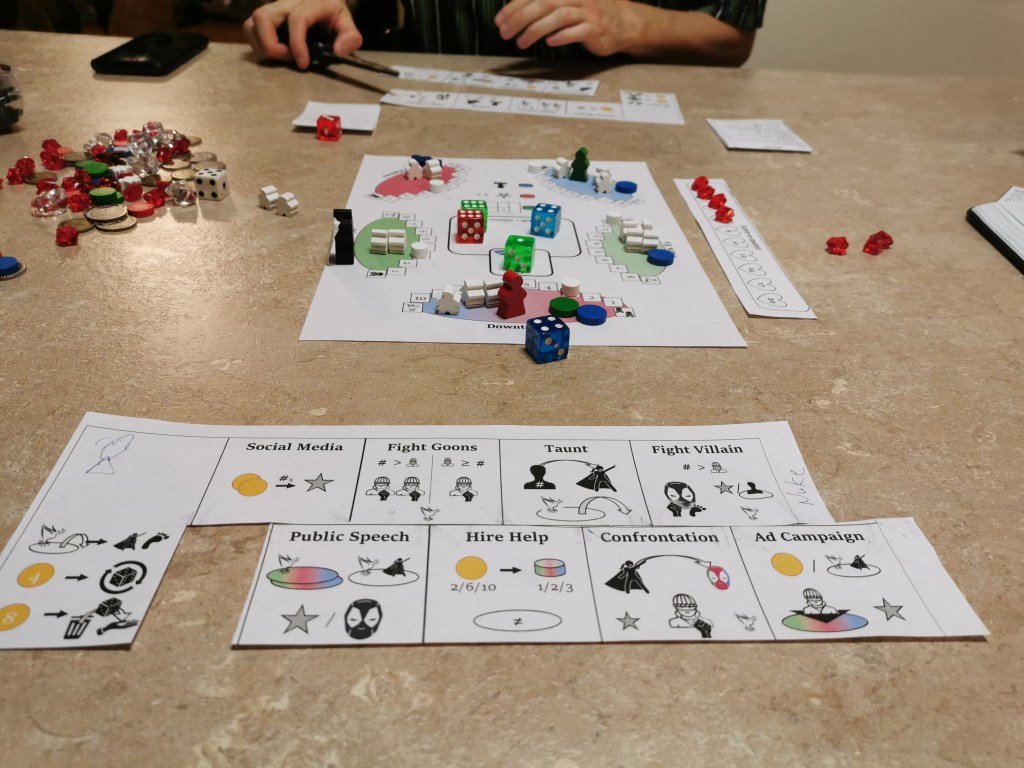
“SuPR is a coop game where you play as a PR firm who just signed a superhero for a client. You’ll have to balance the crime fighting and the TV appearances, and fill up the Love-o-meter before the baddies manage to destroy the city. You’d think saving lives would be enough, right? And of course, you want the best for the city, but… the worse the situation gets, the better it looks when you swoop in and save the day. But if you let stuff get too bad…”
The game is still early in its development, but my pitch is already ready, and honestly, probably my best one in my opinion. It contains multiple hooks: ways to grab people’s attention. There is:
The theme: Superhero, but we’re just the PR firm. I usually get a chuckle, and people do a double take;
Balance crime-fighting and TV appearances: mechanically, it’s the exact same as curing cubes and amassing cards in Pandemic, but the words sound new. By now very few people are uninterested.
Catchphrase: “You’d think saving lives would be enough” will probably be the game’s subtitle. It suggests exactly what I want the game to be about: just saving the world would be easy, and just getting liked would be easy. It’s trying to do both that makes it hard. Again, new words to express a pretty standard feeling in coops.
“The worse the situation gets…”: That part is where the game becomes different. In standard coop, you usually avoid “on the brink” situations as much as possible: in this one, you actually manipulate them into being. This is what makes this game different.
I’m not saying I’m a master pitcher: holy molly am I not. But I think the main difference is nowadays, the pitch is the first thing I think about. I use the #IsThisSomething to share on Twitter ideas I have for games, and if I can’t write what’s interesting in 280 characters, it’s not refined enough. If I get no traction, it’s not interesting enough. Sometimes I go back and work on it, sometimes I just forget about the idea: I have enough game ideas to forget about most of them and still not have enough time to work on the ones that are left.
Writing that pitch also gives me something to design towards, a vision statement of sorts. SuPR was first a roll-and-write game, but when I realized “coop roll and write” was interesting, but not pitch-worthy, I threw it out. When we ran into trouble with earlier versions of Cybertopia, it was much easier to see what we should focus on. With Art Traders, changing from the Puerto Rico lead-and-follow to the one-way track felt like a much bigger change, because it changed The Pitch.
To be completely transparent, I make it look like I do this purposely and in an organized fashion. In reality, it’s more that I let a game marinate for a bit before I work on it. I post about it on Twitter, I talk about it with friends, and through that, I find the kernel that is interesting to me, and that others respond to. Then, eventually, I put it all down on paper.
How early, and how much, do you consider your pitch in your design process?
“Gain X points if you have the most Y” is a phrase that sounds familiar to every board gamer. Majorities are a great way to add indirect interaction and tension to a game, and is often used as either a central mechanism, or a secondary way to score points where it serves to obfuscate an item’s scoring value. I have used many majority aspects in my games, and have learned a few lessons along the way. This series of posts is meant to highlight those axes on which you can play with your system and offer different experiences for the player. Today I’m talking about choices which affect the cognitive load of the mechanism:
Can it be secured? In Acquire, there are 25 shares of each color: at most, I need 13 to secure a majority. Sometimes it’s not a maximum amount to be spread out, but a maximum value a player can have: the Cult tracks in Terra Mystica, and the UN track in Energy Empire, both have a final spot only one player can reach.
Securing it allows you to focus on something else, but it’s also resources and/or actions you could have used to do other stuff: mitigating that risk becomes part of the strategy. It also allows you to file it away in your brain and keep on focusing on something else. It allows you to better evaluate an action’s value: if I need to invest 3 actions in this to gain 10 points, it’s worthwhile, but it isn’t if it takes me 8. And two players who keep one-upping each other is funny to watch for a bit, but it’s slowly taking them out of the running.
If it can’t be secured, that means the tension will never relent. If it’s a secondary scoring aspect, or if you want a more tense, more chaotic, more tactical game, it’s probably not worth adding that math element and making players count those items, because if they can, they will. If their focus is better served elsewhere, don’t give them that information.
How many actions are we supposed to invest in this? It’s a related question. In With a Smile and a Gun, both players compete over Business tokens, which score points for whoever has the most of each type, and Reputation tokens, which are just worth straight points. I tried multiple things for Business tokens, specifically in how many of each type I put out there. In a version, I had 8, 10, and 12 tokens of a type. This diluted their value so much that no one ever cared about them, no matter how many points the majorities were worth. Even when they were brokenly overpowered, players still preferred the sure thing. “Who cares about this one, I can get the next one instead” is a line I heard times and times again. It also often led to majorities being clinched very early in the process, making them worthless for the second half of the game. In the end, I brought them down to 4, 5, and 6, and
I think it’s partly risk aversion, partly optimism, but also related to the fact that, without the majority, those tokens were worthless. In Clans of Caledonia, your main way of scoring points is completing Contracts. In addition to their standard bonuses, the player who completes the most gains an extra 8 points. In games like this, it doesn’t matter if the majority will be won with 4, 8, or 14: you’ve already gotten stuff from your investment, that majority is just icing on the cake.
These are the aspects that go through my mind when I add a majority aspect to my games. Like most great mechanisms, majorities can be customized to do exactly what you want them to do. Are there other twists on the mechanism I have forgotten?
“Gain X points if you have the most Y” is a phrase that sounds familiar to every board gamer. Majorities are a great way to add indirect interaction and tension to a game, and is often used as either a central mechanism, or a secondary way to score points where it serves to obfuscate an item’s scoring value. I have used many majority aspects in my games, and have learned a few lessons along the way. This series of posts is meant to highlight those axes on which you can play with your system and offer different experiences for the player.
Who gains a bonus? Sometimes, you want to give only first place a bonus: sometimes, everyone who participated should gain one, albeit smaller for those further down the competition. I’m sure you’re smart enough to understand the implications of these things. There is a common question about how that interacts with player count, specifically with 2 players, where often a tiny investment is good enough for a large 2nd place bonus. I’m personally a big fan of the Gaia Project way of adding a pre-set value which competes with the players on those majorities and never changes throughout the game. No upkeep, and it adds much of the strategy of a three-player race.
One thing I think is underused in that aspect is negative majorities, where you just don’t want to have the least. They can be problematic, because of loss aversion, and subject to last minute swings, but in the right game can be very fun. Great examples of this are the Fire and Leather tiles in Mammut, Pharaohs in Ra, and how the winner is determined in Lords of Xidit.
This leads to a second, related question:
How are ties handled? A problem with majorities are ties. Often, games default to either “split the points” or “everyone gets the points”, which is fine when majorities are just points, or a secondary feature. However, that can’t always work. It’s also a wasted opportunity to incentivize your players in a direction or another:
With a Smile and a Gun: if there is a tie for first place, the majority is not scored. This is interesting because of the Cop cubes, which players send to each other to mess up their plans: blocking a district from scoring is that mechanism’s main use.
Power Struggle, as mentioned above, gives the tie breaker to whoever played there first, pushing you to play early.
On the opposite side of the spectrum, Lancaster gives the tie breaker to whoever invested there last. This makes it easier to come from behind. It works because of the bonuses for playing on Wars early: otherwise, no one would start going there;
Campy Creatures uses the Clash-o-meter: whoever is on top wins ties, but then goes to the bottom when used
Cybertopia gives the advantage to whoever triggers the scoring: this incentivizes making the Corps score. It also can lead to players feeling like no lead is ever safe -which can be a bug or a feature;
Dice Town has the Sheriff: whoever holds it breaks ties. This pushes bribery and negotiation, and works wonders… but only with the right group.
Can you think of a game with majorities which offers other interesting ways to scale to the number of players, or to determine tie-breakers?
“Gain X points if you have the most Y” is a phrase that sounds familiar to every board gamer. Majorities are a great way to add indirect interaction and tension to a game, and is often used as either a central mechanism, or a secondary way to score points where it serves to obfuscate an item’s scoring value. I have used many majority aspects in my games, and have learned a few lessons along the way. This series of posts is meant to highlight those axes on which you can play with your system and offer different experiences for the player.
When is it evaluated? The entire concept of majorities is that you want the best return on the smallest investment possible. Therefore, the more information you have, the better it is: playing last on a majority is a great advantage. Which begs two questions: (1) why would I invest on it early?, and (2) how aware of the timing of scoring am I?
Unless the majority is secondary (like the Contracts in Clans of Caledonia I mentioned earlier), players will tend to delay their first play on a majority as much as they can, unless (1) you give a bonus to whoever goes there first; or (2) you limit how much a player can invest in a single action. An early adopter bonus can be a straight up bribe (like in Lancaster), or a better investment rate for the majority (like in Terra Mystica, where the first Priest sent to a Cult pushes you up three spaces instead of 2, or even in Power Struggle, where ties are broken by whoever went first).
The timing of the scoring also adds an important question: since I want to place my pawns right before the evaluation, predictability is a strong factor. Some games tell you exactly when that happens, either at the end of the game, or after a pre-set number of turns; others have it happen at random times. However, many games deal with the predictability in interesting ways:
Cybertopia has the players place Viruses on the Corps, which are 5×5 grids, and must place them adjacent to their last placed one. Evaluations are triggered after 2 rows/columns have been completed;
Ethnos triggers the evaluation after the 3rd Dragon card has been played. You have a first “hey start planning for the scoring”, then a second “are you really still pushing your luck?”, and finally a “too late!”;
Power Struggle has one player who determines how many turns happen between two evaluations, but only they know: can you guess from their actions?;
Acquire has majorities matter when two companies are connected on the game board, which means holding a potential connector tile gives you absolute control over when it does… unless somebody else holds one;
Smash Up has scoring happen when the total strength around a base reaches a certain threshold: given that a card’s strength varies between 2 and 6 (mostly), you have an idea of how close you are, but an imperfect one;
The Expanse has scoring triggered by using an action to select a scoring card, when they come up. Whoever uses an action to do so chooses a zone which scores more.
Of course, I have not played every game in the world: are there other timing variants you can think of? Any other twists which offer different experiences?
As a Euro player, I often get a lot of questions when I say that I love interaction in games. Part of it is that some understand interaction as Take That, or trashing your opponents’ stuff down to the ground, while to me, blocking, affecting board state, and majorities all count as satisfying forms of interaction. Another aspect which too often gets forgotten though is what I call the “help me help you”.
HMHY is what I call incentivizing others to take a move which helps you in an otherwise competitive game. These can take many forms, and sometimes lead to a “shake hands” moment, other times to cursing as your opponent is forced to benefit you: to me both of those are strong moments, and should therefore be designed towards. It allows one player to feel clever, it adds a strategic layer to reading your opponents’ positions, and it adds interaction in a Euro-friendly, non-confrontational way.
Before going through examples, let’s discuss the main pitfall that can come up from HMHY: kingmaking. Kingmaking is when the winner is determined not by one of the players competing for it, but by a third party who’s out of the running. It’s considered, by en large, an enormous bug of games with political or negotiation aspects: remember when your sister sold all of her properties to your cousin for 1$ in Monopoly? Yup, that.
I think HMHY is a great solution for kingmaking: by making you win, #3 was doing the best move for them. However, you’re still putting it in their hand: if they don’t, you lose. I think HMHY should either be a minor aspect, where one such action cannot determine the winner, or make sure the players definitive positions are unclear, meaning you’re doing what’s best for you, without knowing for sure if you’re giving someone the game.
The game which best represents HMHY, to me, is Imhotep. To my eyes, this is the central conceit of the game: the more you get to ride other players’ coattails, the more cube-placing actions you have. But because the value of a cube differs so much based on where it’s going, you can’t compete if you always let others decide where your cubes will go. Knowing where others want their cubes to go, and using that opportunity, is where the game’s tactics lie. Riding Coattails is not as much about incentivizing a move, but it’s using the already existing incentive to your advantage.
Another particular example is Lords of Waterdeep, when you add the Scoundrels of Skullport expansion. SoS adds the mechanism of placing extra resources on other spaces: the next player to go there will gain it, in addition to whatever that action gives. There are many strategic ways for you to use it: you place it on a space you built, and therefore get a bonus when other players use them; you are last in turn order and would like someone else to go grab first player; there’s an action you desperately need, and now you can send an opponent likely to take it elsewhere. And of course, each of those makes you feel clever.
Brass is another example of this: many of the buildings require resources, and sometimes, you’ll have to use an opponents’. A large part of the game is about evaluating when demand is about to outgrow offer, and to position yourself to profit from it. Only flipping your mines, and not having help to do so, is a great way to finish last. This adds a layer of mastery to the game, and a need to always stay flexible in your plans: sure, I want to do X, but can I pass over this opportunity to fill up the market with my coal?
Many games have used this concept to make highly interactive games which never feel agressive. It is one of those mechanism that I think is underutilized in today’s market. Maybe the nuance it adds to a game’s strategy is ill-suited for today’s “play-it-once-then-forget-it” market, but I think the staying power of those three games can be seen as evidence of how strong a tool it can be.
Tuesday’s post was presenting two types of non-decisions, which look like decisions from the designer’s POV, but not for players when they experience the game. Those were Arbitrary and Automatic decisions. Today we talk about avoiding them.
So what causes Automatic or Arbitrary decisions? They are two extreme of the same spectrum: Automatic is what happens when you have perfect knowledge of the impact of your decision -making it just a matter of comparing the numbers and choosing the one with the most benefits; Arbitrary is what happens when you have no knowledge of the impact of your decision -meaning all options look the same.
Therefore, stand in the middle. Done, blog post over. Nailed it!
You want a bit more? Oh. Okay.
So I think there are four important things to keep in mind in avoiding non-decisions, and in each, an example of a game I love which does it well:
Opacity is how I describe a game that, through layers of complexity, makes it hard to evaluate impact because of the limits of the human brain. Opacity is often achieved through multiple layers of math, mostly in economic games, but can come from important mechanisms which are not apparent from the get-go. Some will argue it’s a feature because of how clever you feel when you understand it, but I think it is quite problematic: either it leads to arbitrary decisions, because you can’t figure out what each move is worth, or it becomes an automatic decision once you can. I am a fervent advocate of games requiring as little brain juice to understand the rules, to have more left to understand the strategy: to me, opacity is a necessary evil that should be limited as much as possible.
Picture by BGG user Gastgast
A game that achieves depth without being too opaque is Russian Railroads: the impact of an action are as straightforward as can be, whether it’s gaining a new piece, or moving a piece forward. The impacts of a move are also straightforward: this will give you an extra point per turn, but gets you closer to you !-bonus. Instead of having very complex, interconnected systems, it presents them to the players in a really simple way.
Comparability is the ability to compare results. Back when I played Dungeons & Dragons, I had this buddy who just loved big numbers: he had an attack that dealt 20 damage, an attack that dealt 15, and one that dealt 10. Every combat, he’d do his 20, then his 15, then his 10. On the other hand, I had an ability to push enemies, one to stun them, one to teleport to another enemy I could see. Which one was best depended on the situation. Comparing them was more about gut feeling, making the decision interesting.
Picture by Jamey Stegmaier
Wingspan is a great example of a game that makes choices hard to compare: even leaving out round objectives and egg maximums, are you going for the 2-food, 4pt, forest bird which gives you a bonus card; the expensive, 7pt plains bird which can give you an extra point every time you activate it, or for the quick to play, 3pt forest bird which has the same special ability, but a lower chance of success? How are you even supposed to compare those? Because they vary on multiple axes (without becoming opaque), and because of the special abilities which feel very different, it makes those decisions based on the situation rather than a clear cut better option.
Uncertainty is not having an exact value for an action, because its value depends on other things: a random factor (draw the top card from the Building deck and build it right away -but how good is that card?); other players’ actions (the player with the most Honor gains 10 points -how safe is my lead?); or your own future actions (gain an extra wood every time you go to the forest -how often will I get it?).
One thing to keep in mind is that uncertainty can lead to arbitrary decisions if taken too far, and if it isn’t combined with another mitigating factor. “Gain a point every time a blue card is played” is an interesting effect of uncertain result, but if I had to choose between that and “gain a point every time a red card is played”, unless I know what people are likely to play, then it’s arbitrary. If you mitigate it with comparability (gain a point per blue card vs gain a wood per red card), then it’s less arbitrary.
Picture by BGG user Punkin312
One game which uses uncertainty to make decisions interesting is Libertalia. Because of the simultaneous selection, and despite having perfect information of what others have in hand (barring some specific special effects), you can never be certain what the exact impact of your move will be, because the effects of the cards are interrelated.
Interchangeability is a really long word. I really like Euro games, but too many of them end up increasing the number of resources without making them feel different, and in so many games, the choice of a wood vs a brick is the color of the cube. Many games even allow you to pay resources of any type for a lot of things, making what little difference there was even thinner. Most of the time you care because you’re building towards something specific, but by giving each resource a specific niche, you’re making sure those choices stand on their own, not only when an objective requires a specific one.
Picture from BGG user srokaplotkara
Le Havre is an example of a game with a load of different resources, which each feel different, mainly through its two-level, multi-use system. Resources are upgadeable, each type leading to a specific “second level”; some are used for building, some for food, some for energy, and most change use on the second level; some reproduce on their own, while most don’t. All in all, it means that the decision between a Fish and a Coal is never arbitrary, and never automatic.
I think by keeping these four things in mind, the ends of the spectrum become easier to avoid.
One of the most discussed difference between hobby board games and mass market is decisions. When in Monopoly you roll a die to see where you go, in Tokaido you just… choose where you go. That choice is, really, what modern games are about, where strategy and tactics and story and interaction come from. Recently, I’ve been testing a lot of less-than-polished games from other new designers, and I’ve seen two types of non-decisions: they look like decision, but really aren’t.
I’ve played a lot of prototypes that were spinoffs of the card game War. Imagine a game where you had a handful of monster cards, and played them against one another in duels. One player would play one, and the other would respond, highest number gains a point, discard the cards, go again. This would be a crappy game, and a perfect example of both types of non-decisions: the first player had an arbitrary decision, and the second, an automatic decision.
An arbitrary decision is one where you have insufficient information to inform your decision. Not incomplete information -that is actually interesting-, but insufficient to push you one way or the other. If I knew what my opponent had in hand, then I could try and strategize which monsters I’d force them to play, opening things up for the following duel. If the monsters had specific abilities outside of the duel, I could base my choice on those abilities. If the prize differed from one duel to the next, I could choose when to go all in and when to play it safe. But as is, no information means my decision is based on… nothing at all. And therefore, a non-decision.
An automatic decision is the opposite. It’s not only perfect information on the situation, but also clear, directly comparable result. If you play a 6, do I have a card of higher value? Then, I play the lowest one that is still higher. If not, I play my lowest card. That’s it: sure, I can play my 10 on a 3, but that’s just sub optimal.
And you might think “of course, that’s a crappy example of a game just to make your point”, but really, (1) I’ve played games that are pretty close to that, and (2) you’ve played a few prototypes, and probably even a few published games, that rely on non-decisions like that. Will you turn right or left at this intersection? Will you take a bonus red or blue cube? A few decisions like that in a game are annoying, but too many and it’s a problem.
That begs the question: how do you avoid those? If you want to be on the spectrum between arbitrary and automatic, in the good, crunchy Goldilocks zone, how do you make that happen?
Well, as a true blogger, we’ll look at that on Thursday.
There’s a lot of talk in design circles about balance, and how the real focus should be on the illusion of balance, rather than balance itself. I have a cool story about that!
My first game, Cartographia, got signed in 2017. It does new things, but one wheel we didn’t reinvent is “most points wins”. When we pitched it to the publisher that signed it, the final scores were something like 120-80-50. A lot of people who finished in second place felt like they got blown out.
After agreeing with the publisher to change it, we gave everyone an extra 50 points. Not “you each start with 50”, just increasing the value of stuff so that, on average, everyone has higher scores. Scores were now 170-130-100. Suddenly, even though the lead was just as hard to catch up to, players felt better about those scores.
We then halved everything: what gave 4 is now 2, 12 is now 6. You’re smart, you know how halving works. Scores were now 85-65-50, and the point spread was never brought up again.
It would be easy to point to the fact that last place still has 50, and what used to be 70-pts behind is now 35-pts behind: of course they’re okay about that! But in reality, those 35 points now are as hard to get as the 70 before. But the odds of a comeback are not what we care about: the hope is. And that’s emotion, and that just requires re-framing.
All in all, points are a way for the game to compare players’ performances to establish the winner, but players will also compare themselves through it.
It also reminds me of my first game of Heaven & Ale, which is a game I automatically fell in love with. In it, most of your score is your resource that’s lowest on a track (representing how much beer you can produce) multiplied by your beer’s quality (which, IIRC, goes from 2 to 6). But the track starts wayyyyyyy below zero: at the beginning of the game, your lowest resource is at like -12. So, of course, one of my friends finished the game with one resource under 0, and a score of 0. In reality, he scored 0 because you start with -24 points. I think they numbered the track that way to limit the multiplication to lower numbers: you have to play pretty badly to score 0. But when comparing points, it kind of throws everything off, sort of like a graph that doesn’t start at 0.
Do you have a special story about a game’s scoring system, either from a designer or a player perspective? Please share it below, I’d love to read them!

/pic2744318.jpg)



/pic3029488.jpg)
/pic1590236.jpg)
/pic3469216.jpg)
/pic1771926.jpg)
/pic4446124.jpg)
/pic2451196.jpg)
/pic1888084.jpg)


 Subsurface Games